Shandong Fengtu IOT Technology Co., Ltd
Sales Manager:Ms. Emily Wang
Cel,Whatsapp,Wechat:+86 15898932201
Email:info@fengtutec.com
Add:No. 155 Optoelectronic Industry Accelerator, Gaoxin District, Weifang, Shandong, China


Sales Manager:Ms. Emily Wang
Cel,Whatsapp,Wechat:+86 15898932201
Email:info@fengtutec.com
Add:No. 155 Optoelectronic Industry Accelerator, Gaoxin District, Weifang, Shandong, China
time:2025-07-16 09:15:18 source:Weather Station viewed:539 time
In meteorological monitoring, accurate rainfall data is an important basis for the accuracy of weather forecasts. Traditional mechanical rain gauges have problems such as slow response, easy wear, and frequent maintenance, making it difficult to meet the needs of real-time and accurate rainfall monitoring in various modern industries. However, intelligent online rainfall sensors, with their advantages of digitization and automation, have become the mainstream. Here are two recommended high-performance intelligent online rainfall sensors.
FT-Y1 piezoelectric rain gauge
Its principle is based on the piezoelectric effect. When raindrops fall and hit the surface of the sensor, they cause the internal piezoelectric material to deform and generate electric charges. The charge value is proportional to the impact force of the raindrops, which is converted into accurate rainfall information through a signal processing circuit.
It features high measurement accuracy and low error rate, capable of precisely measuring both trace rainfall and heavy rainfall. It has a wide measurement range: the effective piezoelectric panel size is larger than φ200mm, and it can measure a maximum rainfall intensity of 8mm/min, far exceeding that of traditional rain gauges. It responds quickly to instantaneous heavy rainfall, enabling monitoring of the maximum rainfall intensity and its occurrence time. It can also accurately monitor the duration of rainfall, estimate raindrop diameter, and analyze the distribution of rainfall intensity.
Installation is convenient with an integrated design that has no exposed component connecting wires; maintenance is easy as the raindrop contact surface is curved to prevent water accumulation.
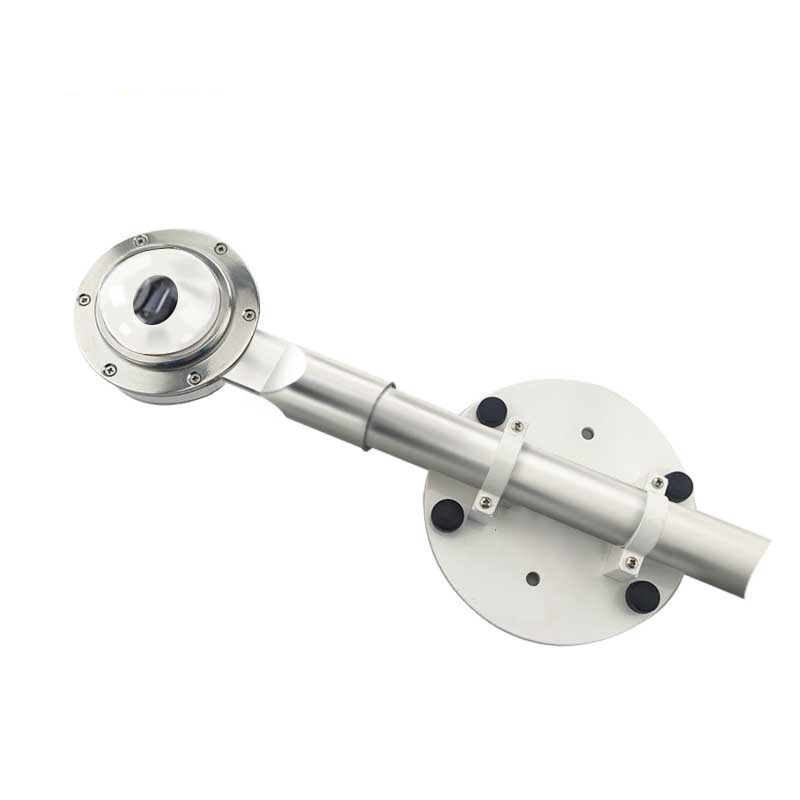
FT-G1 Optical Rain Gauge
Its principle is infrared scanning, achieving non-contact rainfall detection. With electronic optical and microelectronic technologies, its sensitivity is higher than that of traditional mechanical rain gauges.
It has a fully enclosed structure with no mechanical parts, eliminating the need for maintenance or replacement of vulnerable components. It has low installation requirements and does not need to be strictly installed horizontally. Since there are no mechanical parts inside, it can measure during movement without affecting accuracy. Users can modify sensitivity parameters through a programmable light energy monitor according to their needs. It has a built-in tilt sensor that can calibrate rainfall. It has low power consumption, entering deep sleep when there is no rainfall and automatically activating when it rains.
Summary
The two intelligent online rainfall sensors each have their own advantages. The FT-Y1 piezoelectric rain gauge has high measurement accuracy, a wide range, fast response to heavy rainfall, and excellent performance in monitoring rainfall duration, raindrop diameter, etc. It is suitable for fields such as meteorology, hydrology, and water conservancy that have high requirements for the accuracy and richness of rainfall data. The FT-G1 Optical Rain Gauge, with non-contact operation, maintenance-free performance, easy installation, and the ability to measure during movement, is suitable for scenarios such as smart irrigation and geological disaster monitoring.
The high-altitude monitoring lamp is specifically designed for tracking high-altitude migratory pests, such as the Fall Armyworm (*Spodoptera frugiperda*). By leveraging the pests' phototactic behavior—their natural attraction to light—the device lures migratory insects flying at altitud...
In fields such as meteorological monitoring, hydrological research, and urban drainage, the accurate acquisition of rainfall data is of great importance. For a long time, tipping - bucket rain gauges have been widely used. However, as time goes by, their drawbacks have become increasingly apparent.T...
The Visibility detector launched by Fengtu is a high-precision measuring device based on the principle of forward scattering at 35 degrees. It determines the distance of visibility by measuring the scattering intensity of light by gas molecules, aerosol particles and other substances in the air. Thi...
The quotations of agrometeorological stations are comprehensively affected by multiple factors such as equipment configuration and functions.In terms of equipment configuration, the configuration of meteorological sensors determines the price. If only basic temperature and humidity, wind speed and d...


 Skype
Skype
 whatsapp
 mail
mail