Shandong Fengtu IOT Technology Co., Ltd
Sales Manager:Ms. Emily Wang
Cel,Whatsapp,Wechat:+86 15898932201
Email:info@fengtutec.com
Add:No. 155 Optoelectronic Industry Accelerator, Gaoxin District, Weifang, Shandong, China


Sales Manager:Ms. Emily Wang
Cel,Whatsapp,Wechat:+86 15898932201
Email:info@fengtutec.com
Add:No. 155 Optoelectronic Industry Accelerator, Gaoxin District, Weifang, Shandong, China
time:2025-10-14 09:43:17 source:Weather Station viewed:576 time
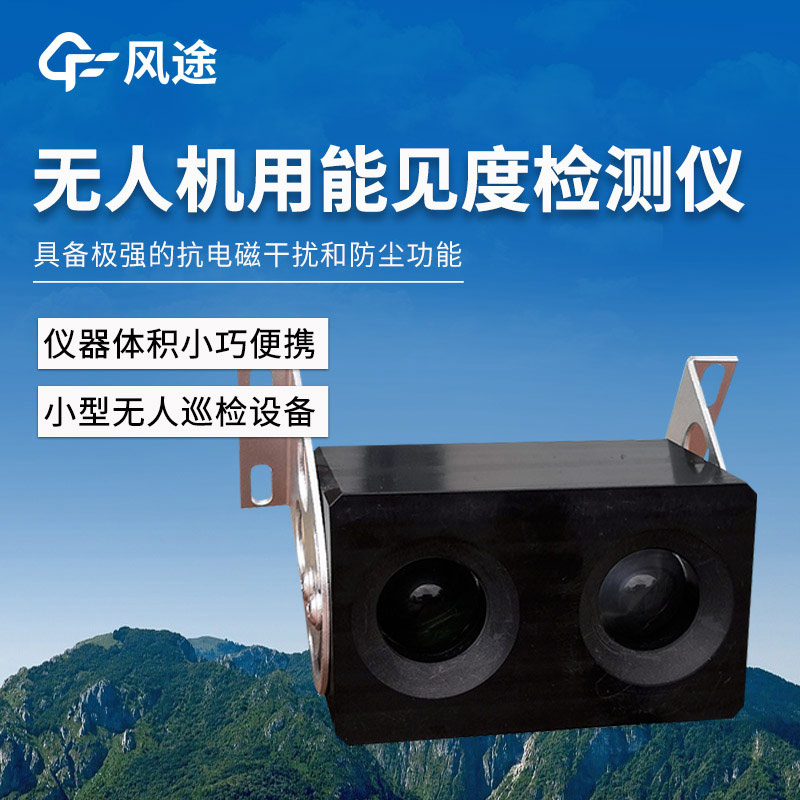
The UAV Visibility Meter is a high-precision optical device integrated into an unmanned aerial vehicle (UAV) platform, operating on the principle of forward scattering. The instrument emits infrared light beams of specific wavelengths and accurately measures the scattered light intensity of airborne suspended particles at a 35° scattering angle, thereby analyzing and calculating the atmospheric extinction coefficient to obtain real-time visibility values.
The greatest features of this type of instrument are its lightweight design, low power consumption, and strong environmental adaptability, making it ideal for mobile, three-dimensional meteorological observations mounted on UAVs.
The design fully considers the practical needs of aerial operations. To adapt to small UAV platforms, the weight can be as light as 110 grams, and power consumption is generally as low as 0.9W, which can effectively extend the flight time of UAVs.
Through digital interfaces such as RS485 and Bluetooth, the detector can continuously refresh and transmit visibility data at a frequency of approximately once every 10 seconds, enabling real-time monitoring.
On highway sections prone to fog or airport runways, UAVs can conduct inspections and monitor visibility changes in real-time, providing crucial data for traffic control and flight scheduling.
UAVs can compensate for the limitations of fixed ground monitoring stations, acquiring visibility data at different altitude levels and providing more three-dimensional data support for weather forecasting and climate research.
Technical Parameters:
Detection Range: 10-4000 meters
Measurement Accuracy: ±15%
Light Source: IR LED
Response Time: 10 seconds
Digital Output: RS485, RS232, SDI-12
Bluetooth Output: BLE5.0 (optional)
Operating Temperature: -20-50°C
Operating Humidity: 0-95%
Power Supply Voltage: VDC 12-24V
Power Consumption: 0.9W
In fields such as meteorological monitoring, hydrological research, and urban drainage, the accurate acquisition of rainfall data is of great importance. For a long time, tipping - bucket rain gauges have been widely used. However, as time goes by, their drawbacks have become increasingly apparent.T...
Lightning Warning System, based on atmospheric electric and magnetic field detection technology, can monitor changes in the atmospheric electrostatic field in real time and issue warnings before lightning strikes, enabling localized short-term lightning activity warnings....
This crop growth monitoring equipment is an automated agricultural monitoring system. It uses a high-definition camera to collect real-time daytime and nighttime infrared images of crop growth and development. Combined with meteorological and soil moisture sensors and pest forecast lights, it...
As a special section in the transportation network, tunnels, with their enclosed environment, are susceptible to factors such as vehicle exhaust, air flow changes, and light differences. Professional monitoring equipment is therefore needed to ensure traffic safety. The following introduces four key...


 Skype
Skype
 whatsapp
 mail
mail