Shandong Fengtu IOT Technology Co., Ltd
Sales Manager:Ms. Emily Wang
Cel,Whatsapp,Wechat:+86 15898932201
Email:info@fengtutec.com
Add:No. 155 Optoelectronic Industry Accelerator, Gaoxin District, Weifang, Shandong, China


Sales Manager:Ms. Emily Wang
Cel,Whatsapp,Wechat:+86 15898932201
Email:info@fengtutec.com
Add:No. 155 Optoelectronic Industry Accelerator, Gaoxin District, Weifang, Shandong, China
time:2025-01-23 09:00:48 source:Weather Station viewed:622 time
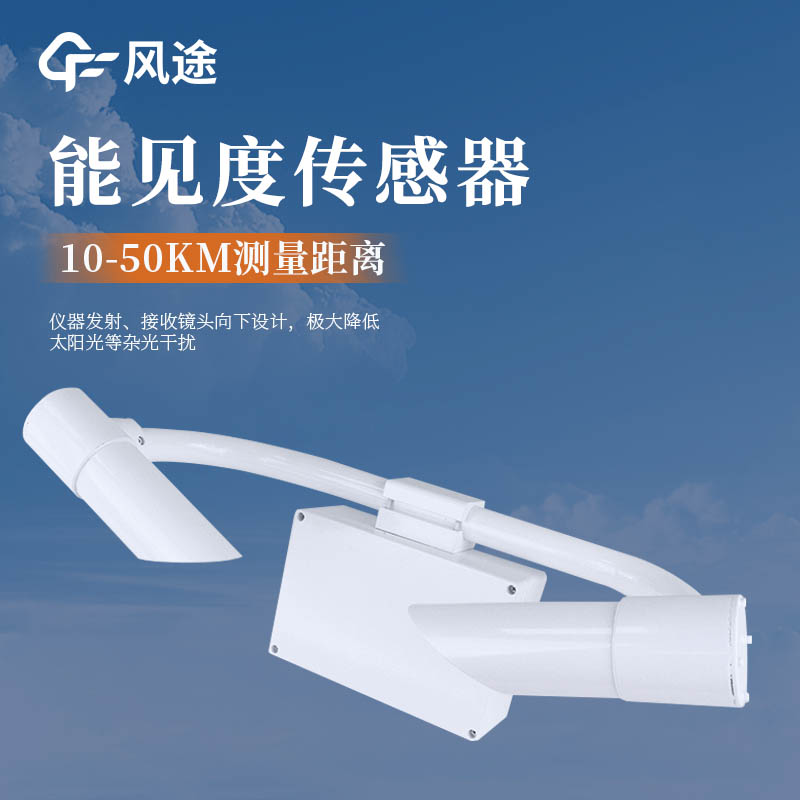
In the modern meteorological monitoring system, the Visibility sensor has achieved functional expansion and upgrade. It can not only accurately monitor visibility but also identify various weather phenomena, so it is called a visibility weather phenomenon instrument.
This instrument is mainly based on the forward scattering or backward scattering principle. It uses optical components to emit light beams of specific wavelengths. When the light beams propagate in the atmosphere, they will be scattered and attenuated due to gas molecules, aerosol particles in the air, and suspended particles caused by various weather phenomena. The instrument uses a highly sensitive detector to precisely capture information such as the intensity and angular distribution of the scattered light. After complex algorithm processing, it calculates the atmospheric extinction coefficient and then determines the visibility value.
At the same time, the visibility weather phenomenon instrument integrates sensing technology and intelligent algorithms, enabling it to identify and analyze the unique optical and physical property changes caused by different weather phenomena. For example, in rainy weather, the size, density, and distribution of raindrops will cause the light beam to have a specific scattering pattern. By analyzing the changing characteristics of the scattered light, the instrument can not only determine the occurrence of rain but also distinguish different magnitudes of rain, such as light rain (precipitation of 0.1 - 9.9 mm/day), moderate rain (precipitation of 10 - 24.9 mm/day), and heavy rain (precipitation of 25 - 49.9 mm/day), based on the difference in the degree of light attenuation by raindrops.
For snowfall, the shape, size, and falling speed of snowflakes result in different light scattering and reflection characteristics compared to rainfall. The instrument can identify snowfall weather by analyzing these characteristics and can roughly estimate the snowfall intensity according to the influence of snow crystals on light.
In the monitoring of fog and haze, the visibility weather phenomenon instrument discriminates between fog (relative humidity greater than 90%, consisting of a large number of tiny water droplets) and haze (relative humidity less than 80%, mainly composed of dry dust particles and other pollutants) by comprehensively detecting and analyzing parameters such as the concentration and particle size distribution of suspended particulate matter in the atmosphere and humidity, and can further assess their severity.
Transportation departments such as those in charge of highways and railways can grasp the meteorological conditions along the routes in real - time based on the data fed back by the visibility weather phenomenon instrument. When the visibility decreases or severe weather phenomena occur, corresponding traffic control measures can be taken in a timely manner. For example, on highways, speed limits can be imposed (such as when the visibility is less than 200 meters, the speed should not exceed 60 km/h), and roads can be closed, effectively preventing traffic accidents caused by severe weather.
Electric field sensors are core devices for high-precision lightning monitoring. Capable of capturing dynamic changes in the atmospheric electric field in real-time, they leverage ultra-high measurement accuracy and rapid response capabilities to provide precise lightning early-warning data fo...
Portable Weather Station is a highly integrated, portable, and rapidly deployable automatic weather observation device. It incorporates sensors, a data logger, a power supply system, and a communication module into a compact housing or mast. Its core features can be summarized as "portable, rap...
Agricultural Weather Station is a highly integrated, low-power, and rapidly deployable high-precision meteorological observation device designed specifically for farmland monitoring scenarios. Compliant with the requirements for high-standard farmland construction, the device comes bundled wit...
This lamp converts solar energy into electricity using a solar panel. At night, it powers an LED insect-attracting light source that releases specific wavelengths to attract phototactic pests. A fan generates negative pressure airflow, drawing the pests into a collection box where they are dri...


 Skype
Skype
 whatsapp
 mail
mail