Shandong Fengtu IOT Technology Co., Ltd
Sales Manager:Ms. Emily Wang
Cel,Whatsapp,Wechat:+86 15898932201
Email:info@fengtutec.com
Add:No. 155 Optoelectronic Industry Accelerator, Gaoxin District, Weifang, Shandong, China


Sales Manager:Ms. Emily Wang
Cel,Whatsapp,Wechat:+86 15898932201
Email:info@fengtutec.com
Add:No. 155 Optoelectronic Industry Accelerator, Gaoxin District, Weifang, Shandong, China
time:2025-07-01 09:32:41 source:Weather Station viewed:603 time
Tea gardens are prone to a variety of pests, including common ones like the tea green leafhopper, tea geometer, tea tussock moth, black citrus aphid, and tea orange mite. The tea green leafhopper feeds by sucking the sap from tender tea shoots, causing leaves to lose greenness, wither, and hinder shoot growth; the tea geometer heavily chews leaves, and in severe cases, can defoliate tea trees completely, leaving only branches. These pests not only reduce tea yield but also significantly degrade tea quality by affecting its tenderness and taste. Although traditional chemical pesticide control has some effect, pesticide residues seriously threaten human health, disrupt the tea garden ecosystem, and lead to increased pest resistance. Therefore, green protection methods have become an inevitable choice for tea garden pest control.
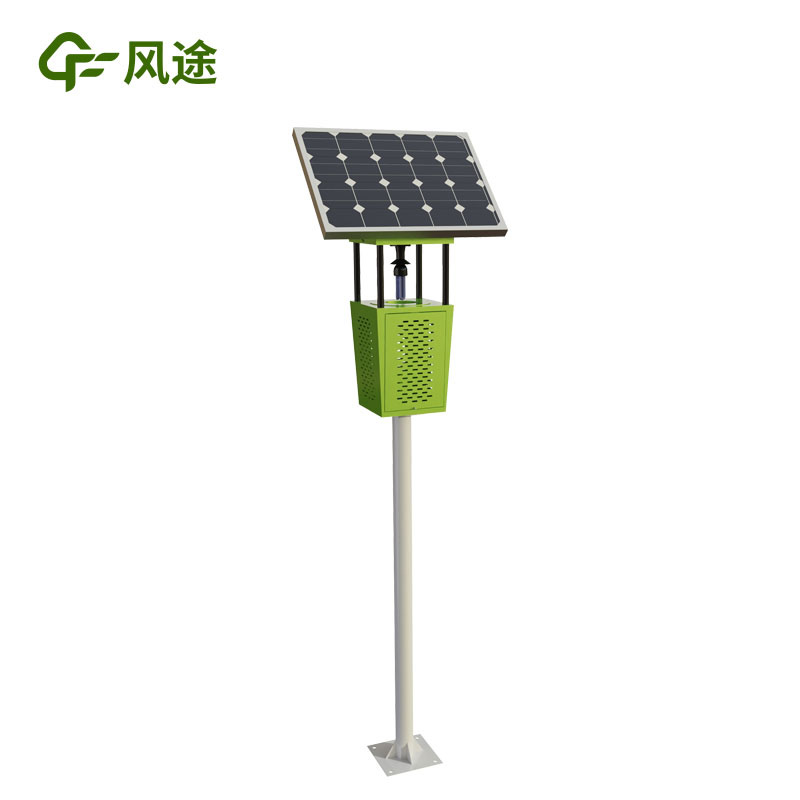
The Solar Insecticidal Lamp FT-FD1S provides an effective solution for green pest control in tea gardens, integrating insect trapping technology, solar energy technology, and physical trapping technology. Equipped with high-efficiency solar panels, the device converts solar energy into electricity during the day and stores it in the built-in battery. When night falls and the light intensity drops below the set value, the device starts automatically. The built-in LED lamp emits light within a specific wavelength range of 320nm–680nm, precisely simulating the light waves favored by pests such as tea geometers and tea green leafhoppers. Attracted by the light, adult pests flock to the light source, triggering the built-in fan to operate and generate a strong negative pressure airflow, forming a low-pressure zone around the lamp. Pests near the light source are quickly sucked into the insect collection box by the negative pressure. The relatively enclosed box causes pests to dry out and die due to lack of water and food, eliminating pesticide residue risks from the source and highly aligning with the green production concept of tea gardens.
Tea gardens are mostly distributed in open areas such as mountains and hills, rich in light resources, creating favorable conditions for the Solar Insecticidal Lamp to maintain stable power supply and operate normally throughout the high pest season. The lamp has a wide coverage area: one device has an effective control radius of about 120m, covering 3–5 mu of tea gardens. The physical pest control method targets only phototactic pests, causing no harm to beneficial insects like bees.
Overall, the device features a compact structure and simple installation, requiring no complex wiring, making it highly adaptable to the complex terrain and scattered tea tree distribution in tea gardens. It can be flexibly deployed in both large contiguous tea gardens and small hilly ones.
Considering the rainy and humid environment of tea gardens, FT-FD1S is made of waterproof and anti-corrosion materials, enhancing durability, extending service life, and reducing post-maintenance frequency and cost.
Plant Growth Monitoring facilitates real-time monitoring of crop growth and development, pest and disease outbreaks, and disaster conditions through both daytime and nighttime infrared video feeds. By integrating meteorological sensors, soil moisture sensors, and pest forecasting lamps, the sy...
Small automatic weather stations are an important part of the meteorological monitoring and management platform, and they play a crucial role especially in the information release subsystem. Before the arrival of meteorological disasters, small automatic weather stations can quickly release early wa...
How to measure "visibility"?I. Visual Estimation MethodThis is a rather traditional and simple approach. Observers use their naked eyes to observe target objects. For example, during the day, they select mountains, buildings, etc. that have a sharp contrast in color and shape with the back...
A Portable Weather Station is an all-weather integrated meteorological observation device. Designed with a portable structure, it features a highly integrated collector and sensors, allowing for immediate measurement upon unpacking without complex installation or disassembly. It is characterized by...


 Skype
Skype
 whatsapp
 mail
mail