Shandong Fengtu IOT Technology Co., Ltd
Sales Manager:Ms. Emily Wang
Cel,Whatsapp,Wechat:+86 15898932201
Email:info@fengtutec.com
Add:No. 155 Optoelectronic Industry Accelerator, Gaoxin District, Weifang, Shandong, China


Sales Manager:Ms. Emily Wang
Cel,Whatsapp,Wechat:+86 15898932201
Email:info@fengtutec.com
Add:No. 155 Optoelectronic Industry Accelerator, Gaoxin District, Weifang, Shandong, China
time:2025-08-26 09:48:12 source:Weather Station viewed:516 time
Traditional pest monitoring is labor-intensive and time-consuming, making it difficult to meet the needs of production efficiency. However, the Insect Monitoring System successfully addresses this issue through the integration of interdisciplinary theories and modern technologies. It is not a simple accumulation of knowledge and technologies, but adopts a closed-loop design of "theory guiding technology and technology feeding back to theory". This shifts monitoring from "experience-based judgment" to "data-driven decision-making", which not only reduces labor costs and improves efficiency, but also enhances monitoring accuracy, providing reliable forecasts for researchers and growers.
Every step of the system's operation is designed around "monitoring accuracy": it uses light to trap pests by matching their phototaxis. When dealing with insect bodies using far-infrared technology, a mortality rate of over 98% and an integrity rate of over 95% balance the needs of "thorough insect killing" and "usable samples", preventing insect body damage or pest escape from affecting AI recognition. Subsequent processes such as drying, vibrating to evenly distribute insects, and conveying insects via a conveyor belt all serve the purpose of capturing "clear samples" with high-definition cameras, reflecting the advancement from "function realization" to "experience optimization".
Automation is one of its core advantages. The system supports an unattended mode and can complete the entire process of insect trapping, killing, photographing, and data transmission 24 hours a day. It is particularly suitable for remote or large-area planting regions, solving the problems of "difficulty in stationing personnel" and "easy missed detection" in traditional monitoring. At the same time, data is uploaded to the platform in real time and visualized. Long-term accumulation can form a "regional pest database", which provides support for formulating prevention and control policies and realizes the upgrade from "single-point early warning" to "whole-region prevention and control".
This system has a wide range of applications, covering multiple scenarios such as farmland, forestry, and gardens. Its "multi-scenario adaptability" stems from technical compatibility with the characteristics of pests in different fields. It can adjust parameters to meet different needs, becoming a universal tool for cross-field monitoring. With the development of smart agriculture, it can also be linked with irrigation and fertilization systems, which will further expand its application value.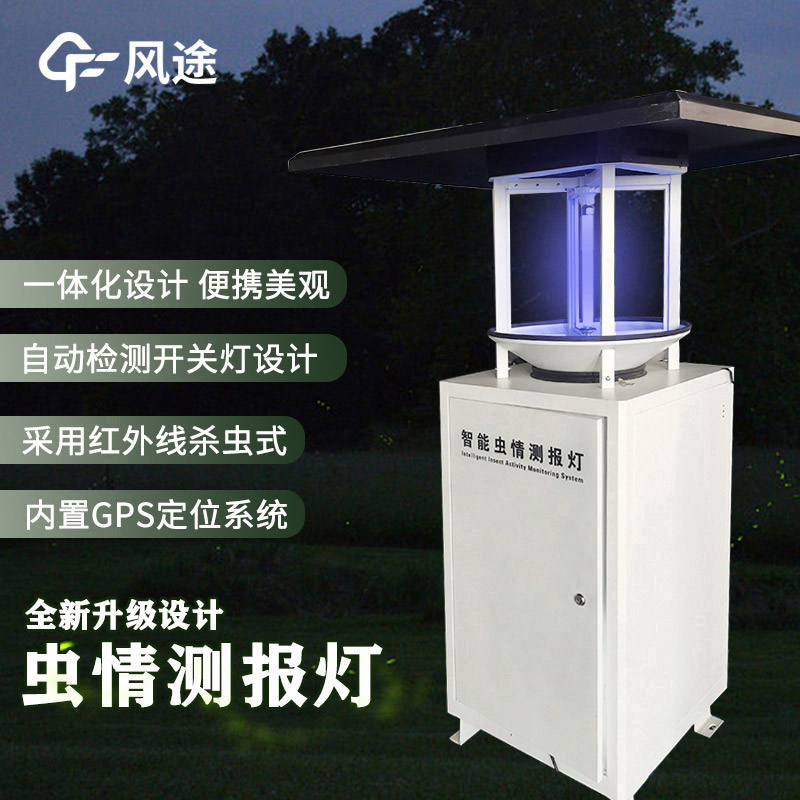
Low-visibility weather conditions such as fog, haze, precipitation, and sandstorms not only cause great inconvenience to travel but also frequently trigger major accidents, leading to severe casualties and economic losses. However, the existing Doppler weather radars in meteorological and environmen...
The Agricultural monitoring system is a comprehensive agricultural informatization system integrating the monitoring of crop growth, soil moisture, meteorological conditions, and plant diseases and insect pests. Due to its precise monitoring capabilities, it is vividly known as the "clairvoyant...
Integrating Beidou-3 short message communication with meteorological monitoring technology, the Beidou meteorological station employs an integrated eight-element sensor to monitor wind speed and direction, temperature and humidity, air pressure, optical rainfall, total radiation, and negative...
In precipitation measurement, while rain gauges and tipping-bucket rain sensors enable convenient and accurate fixed-point observation, their coverage density is generally low in remote areas with sparse human population due to constraints on deployment conditions. This makes it difficult to effecti...


 Skype
Skype
 whatsapp
 mail
mail