Shandong Fengtu IOT Technology Co., Ltd
Sales Manager:Ms. Emily Wang
Cel,Whatsapp,Wechat:+86 15898932201
Email:info@fengtutec.com
Add:No. 155 Optoelectronic Industry Accelerator, Gaoxin District, Weifang, Shandong, China


Sales Manager:Ms. Emily Wang
Cel,Whatsapp,Wechat:+86 15898932201
Email:info@fengtutec.com
Add:No. 155 Optoelectronic Industry Accelerator, Gaoxin District, Weifang, Shandong, China
time:2026-07-31 10:41:05 source:Weather Station viewed:24 time
Lightning monitors are fully digital electric field detection and early warning devices based on the principle of charge induction and MEMS technology. They have no easily worn parts such as motors, resulting in small size and low power consumption. Employing an electric field differentiation combined with a threshold optimization algorithm, they effectively avoid false alarms caused by weather factors, achieving high early warning accuracy. They are suitable for aerospace, meteorology, power grids, petrochemical, and other fields.
Lightning monitors are specialized devices used to monitor changes in the atmospheric electric field in real time and provide short-term early warnings of lightning activity. The core detection structure of this device is based on the principle of charge induction and is developed using MEMS (Micro-Electro-Mechanical Systems) technology. The entire system does not contain easily worn moving mechanical parts such as motors, thus possessing outstanding advantages such as small size, low power consumption, high reliability, and ease of integration. Compared with traditional devices using mechanical electric field sensors, the application of MEMS technology significantly reduces the maintenance requirements and failure rate of the equipment, enabling it to operate stably for extended periods in unattended outdoor environments.
Regarding the lightning early warning algorithm, the lightning monitor employs an optimization scheme combining electric field differentiation and threshold values. Conventional threshold methods are susceptible to false alarms due to weather conditions such as rain, strong winds, snow, and dust storms. The electric field differential method, however, effectively distinguishes between changes in the ambient electric field and changes in the electrostatic field of thunderclouds, thus largely avoiding false alarms caused by human interference and further improving the accuracy of the warning. The system provides three levels of audible and visual alarms, with a warning radius of up to 15 kilometers, an electric field measurement range of -100kV/m to 100kV/m, and a resolution of 0.1V/m.
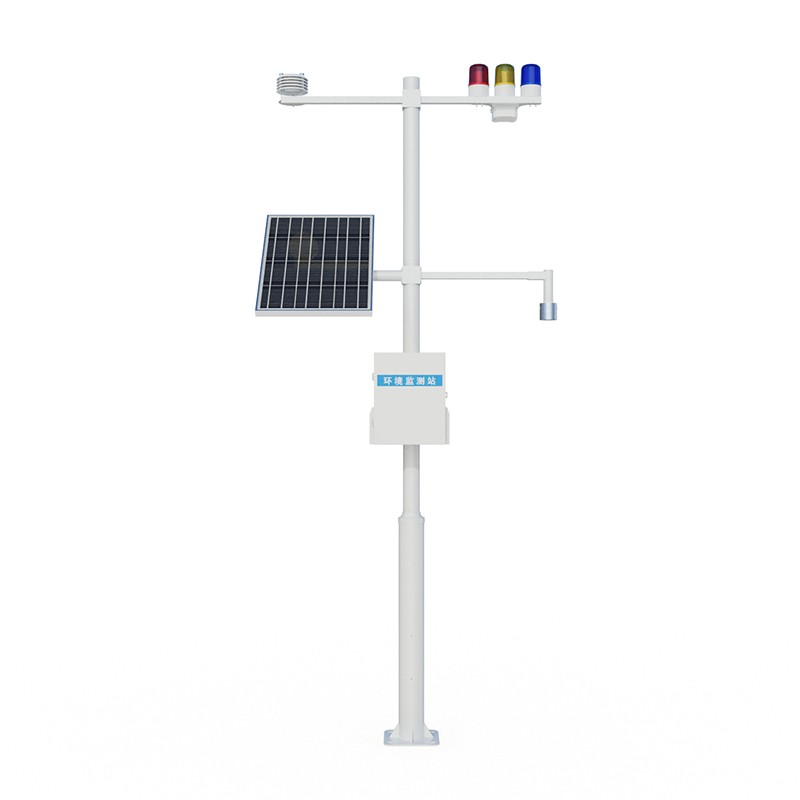
The lightning monitoring instrument consists of a lightning warning probe, a data processing host, a solar power system, a surge system, a grounding system, air temperature, humidity, and atmospheric pressure sensors, a three-level audible and visual alarm, and a cloud-based data query and real-time display module. The system supports both RS485-Modbus-RTU and RS485-json management interfaces, and data is transmitted via GPRS every 60 seconds, with a monthly data usage requirement of approximately 100MB. Users can connect the device probe to a cloud server for remote monitoring. Data analysis allows for more accurate assessment of the intensity and polarity changes of the electrostatic field in thunderclouds. The sensor weighs only 710g, the entire unit weighs 36kg, the sensor dimensions are 105×78mm, the pole support height is 3m, and the sensor installation height is 1.8m.
This lightning monitoring instrument primarily addresses the atmospheric electric field detection and localized short-term lightning warning applications in aerospace, defense, meteorology, petrochemical, power grid, scenic areas, mines, oil depots, and military fields. The equipment can operate independently or support network monitoring. It is easy to install, provides accurate warnings, and offers reliable data support and early warning assurance for lightning protection and disaster mitigation efforts in various important facilities and locations.
The Visibility Sensor is a specialized sensor device designed for automatic and continuous monitoring of atmospheric visibility, playing a vital role in fields such as meteorological observation and environmental monitoring. Its core working mechanism is based on the principle of forward scattering....
Meteorological visibility refers to the maximum horizontal distance at which a person with normal vision can see and identify a target object against the sky background under current weather conditions (usually measured in meters or kilometers).Transportation is the industry that needs visibility da...
Agricultural Weather Stations accurately senses meteorological and soil data, providing intelligent early warnings to guide agricultural activities and offering scientific decision-making support for modern farming....
The wind-suction solar insect trap consists of a solar panel, a storage battery, an intelligent controller, an LED insecticidal lamp, a wind-suction mechanism, and a collection bin. It stores electrical energy during the day and operates at night, utilizing negative airflow to draw pests into...


 Skype
Skype
 whatsapp
 mail
mail