Shandong Fengtu IOT Technology Co., Ltd
Sales Manager:Ms. Emily Wang
Cel,Whatsapp,Wechat:+86 15898932201
Email:info@fengtutec.com
Add:No. 155 Optoelectronic Industry Accelerator, Gaoxin District, Weifang, Shandong, China


Sales Manager:Ms. Emily Wang
Cel,Whatsapp,Wechat:+86 15898932201
Email:info@fengtutec.com
Add:No. 155 Optoelectronic Industry Accelerator, Gaoxin District, Weifang, Shandong, China
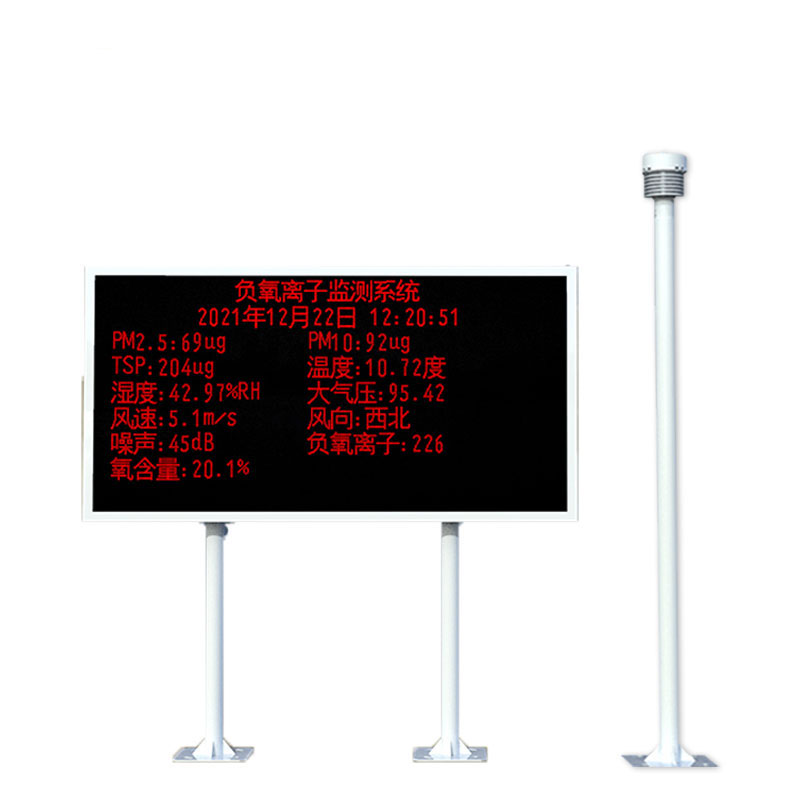
Model:FT-FZ3
Brand:fengtu
1.Negative oxygen ion monitoring station product introduction
The negative oxygen ion monitoring station can monitor the concentration of negative oxygen ions in the air around the clock, and can expand monitoring items according to user needs, such as: air temperature, air humidity, PM2.5, PM10, atmospheric pressure, oxygen content, noise, wind speed, wind direction and other meteorological elements; modular structure design, sensors can be replaced individually, equipped with professional installation brackets, data can be read directly on-site through the LED screen, and data can be viewed in real time on the remote cloud platform/WEB/WeChat public account, which is convenient for later operation and maintenance.
2.Application scope of negative oxygen ion monitoring station
Tourist attractions, ecological estates, wetland parks, waterfall parks, forest parks, nature reserves, sales offices, schools
3.Technical parameters of negative oxygen ion monitoring station
1.Wind speed: Measurement principle: ultrasonic, 0-60m/s (±0.1m/s), resolution: 0.01m/s; (invention patent, patent number: ZL 2021 1 0237536.5)
2.Wind direction: Measurement principle: ultrasonic, 0-360° (±2°), resolution: 1°; (invention patent, patent number: ZL 2021 1 0237536.5)
3.Air temperature: Measurement principle: diode junction voltage method, -40-60℃ (±0.3℃), resolution 0.01℃; (Calibration certificate from Beijing Meteorological Bureau)
4.Air humidity: Measurement principle: capacitive, 0-100%RH (±0.3%RH), resolution: 0.1%RH; (Calibration certificate from Beijing Meteorological Bureau)
5.Atmospheric pressure: Measurement principle: piezoresistive, 300-1100hpa (±0.25%), resolution: 0.1hpa; (Calibration certificate from Beijing Meteorological Bureau)
6.PM2.5: Measurement principle: light scattering, 0-1000ug/m3 (±10%), resolution: 1ug/m3
7.PM10: Measurement principle: light scattering, 0-1000ug/m3 (±10%), resolution: 1ug/m3
8.Noise: Measurement principle: Capacitive, 30-120dB (±1.5dB) Resolution: 0.1db
9.Negative oxygen ions: Measurement principle: cylindrical electrode inhalation type, 0-100,000/cm³ (±10%), resolution: 1/cm³
10.Oxygen content: Measurement principle: electrochemical, 0~25%Vol (±3%FS) resolution: 0.1%
11.Data storage: can store one year's original monitoring data;
12.Data transmission: GPRS/4G/optical fiber
13.Power consumption: 800w
14.Power supply: 220V mains electricity, solar energy (optional)
15.Working environment: temperature -40℃-60℃, humidity 0%-100%
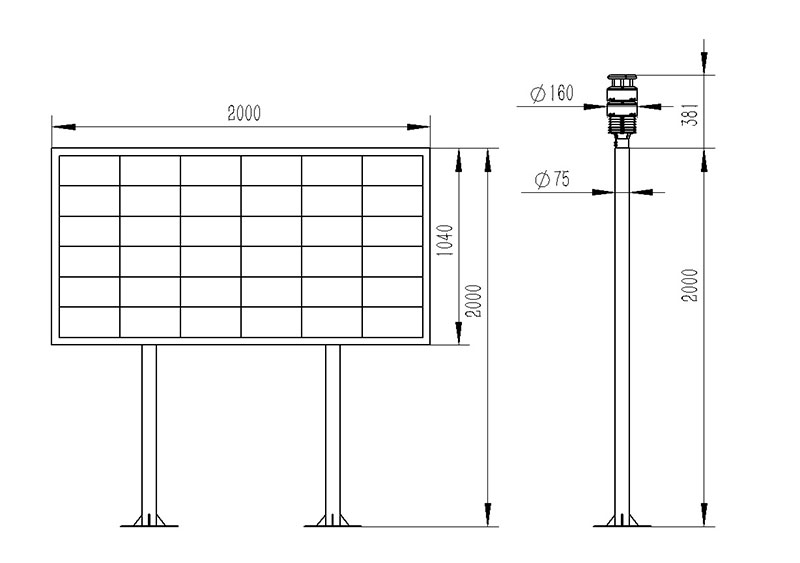
16.Screen: 2m*1m, composed of 36 P10 single red unit panels, unit panel size 32cm*16cm
17.Pole: Carbon steel double column, each column is made of two 1.5-meter pole flanges connected together, can withstand a strong typhoon of level 15
18.The manufacturing enterprise has ISO quality management system, environmental management system and occupational health management system certification
19.The manufacturer has a computer software registration certificate
20.The manufacturer is a 3A credit enterprise
4.Features of Negative oxygen ion monitoring station
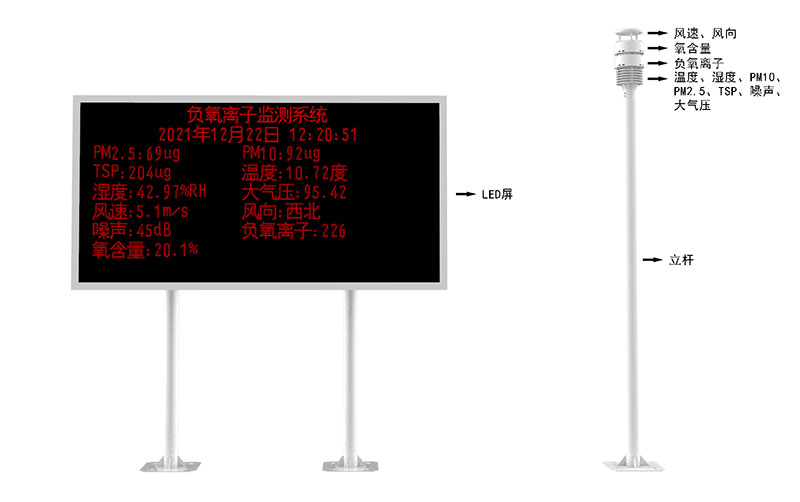
1.High integration and flexible solutions: The system can integrate negative oxygen ions, air temperature, air humidity, PM2.5, PM10, atmospheric pressure, oxygen content, noise, wind speed, and wind direction
2.Stable system: We have cooperated with thousands of parks and scenic spots, with stable backend operation, maintenance-free and low failure rate
3.Multiple transmission: The transmission method can be customized according to the on-site network conditions, 2G/4G/optical fiber
4.Support expansion: support sensor expansion, 485 interface, modbus protocol sensors can be used directly
5.Various display schemes: point-to-point, point-to-multiple, and multi-to-point LED screen data display schemes can be selected according to on-site needs
5.Negative oxygen ion monitoring station product structure diagram
6.Negative oxygen ion monitoring station product dimensions
7.Introduction to Negative oxygen ion monitoring station cloud platform
1.CS architecture software platform, supports direct observation through mobile phones and PC browsers, without the need to install additional software.
2.Support multiple accounts and multiple devices to log in
3.Support real-time data display and historical data display dashboard
4.Cloud servers and cloud data storage are stable, reliable, easy to expand, and load balanced.
5.Support SMS alarm and threshold setting
6.Support map display and view device information.
7.Support data curve analysis
8.Support data export in table format
9.Support data forwarding, HJ-212 protocol, TCP forwarding, http protocol, etc.
10.Support data post-processing function
11.Support external running of javascript scripts
The visibility detector can quickly transmit accurate fog information to the command center by monitoring the changes in visibility on expressways in real time, providing crucial basis for the decision-making of the traffic management department and completely changing the extensive management mode...
The Atmospheric electric field meter is a scientific instrument specifically designed to measure atmospheric electric field strength and its variations. Its measurement range covers -100 kV/m to 100 kV/m. This device provides early warning of lightning activity by monitoring changes in the atmospheric electric field in real time. It has significant application value in aerospace, national defense, smart grids, petrochemicals, and meteorological observation, providing data support for disaster prevention and safe production....
Agricultural Environment Monitoring System is a field environmental monitoring equipment composed of five parts: meteorological sensors, data collector, solar power supply system, pole support, and cloud platform. This system features easy installation and rapid deployment, automatically collecting and remotely transmitting environmental data such as temperature and humidity. It is widely used in agriculture, forestry, and scientific research....
In precipitation measurement, while rain gauges and tipping-bucket rain sensors enable convenient and accurate fixed-point observation, their coverage density is generally low in remote areas with sparse human population due to constraints on deployment conditions. This makes it difficult to effecti...


 Get a Free Quote
 Skype
Skype
 whatsapp
 mail
mail