Shandong Fengtu IOT Technology Co., Ltd
Sales Manager:Ms. Emily Wang
Cel,Whatsapp,Wechat:+86 15898932201
Email:info@fengtutec.com
Add:No. 155 Optoelectronic Industry Accelerator, Gaoxin District, Weifang, Shandong, China


Sales Manager:Ms. Emily Wang
Cel,Whatsapp,Wechat:+86 15898932201
Email:info@fengtutec.com
Add:No. 155 Optoelectronic Industry Accelerator, Gaoxin District, Weifang, Shandong, China
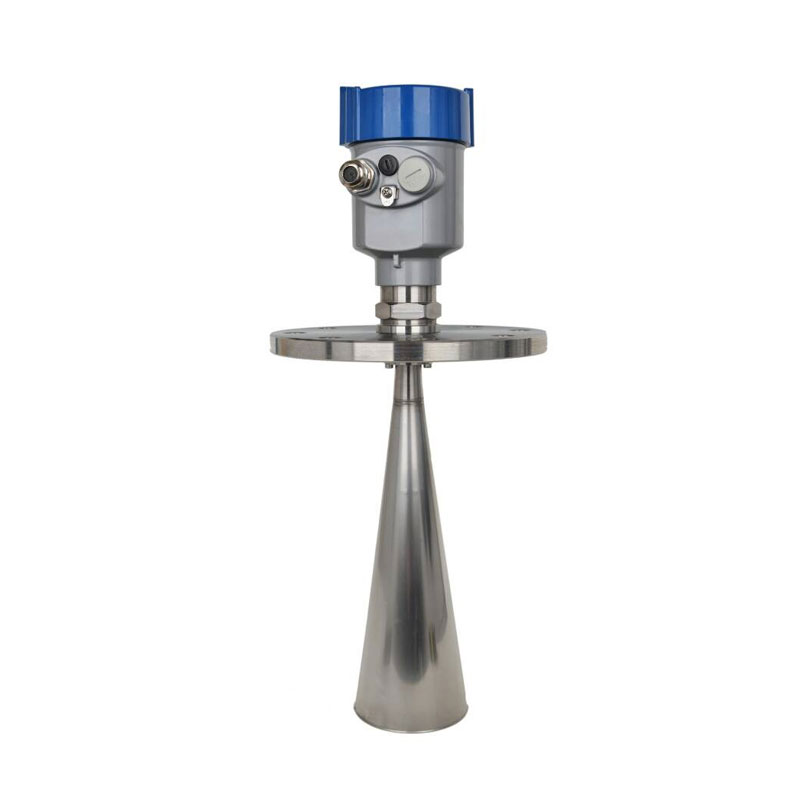
Model:WW-26
Brand:fengtu
1.Radar level meter product principle
The radar level antenna emits a narrow microwave pulse, which is transmitted downward through the antenna. After the microwave contacts the surface of the measured medium, it is reflected back and received by the antenna system again, and the signal is transmitted to the electronic circuit part and automatically converted into a level signal (because the microwave propagation speed is extremely fast, the time taken for the electromagnetic wave to reach the target and return to the receiver through reflection is almost instantaneous).
2. Radar level meter technical parameters
Application: solid materials, strong dust, easy to crystallize, condensation occasions
Measuring range: 30 meters
Process connection: Universal flange
Medium temperature: -40~250℃
Process pressure: -0.1~0.1MPa
Accuracy: ±15mm
Protection level: IP67
Frequency range: 26GHz
Explosion-proof grade: Exia ⅡC T6 Ga/Exd ia IIC T6 Gb
Signal output: 4...20mA/HART (two-wire/four-wire), RS485/Modbus
3. Radar level meter product features
The antenna is small in size and easy to install; it is a non-contact radar, without wear and pollution.
Almost unaffected by corrosion and foam; almost unaffected by water vapor, temperature and pressure changes in the atmosphere.
Severe dust environment has little effect on the operation of high-frequency level meters.
The shorter the wavelength, the better the reflection from inclined solid surfaces.
The small beam angle and concentrated energy enhance the echo capability while helping to avoid interference.
The measurement blind area is smaller, and good results can be achieved even for small tank measurements.
High signal-to-noise ratio for better performance even under fluctuating conditions.
High frequency, the best choice for measuring solids and low dielectric constant media.
These systems are multi-element monitoring systems developed specifically for the local meteorological environment of power transmission line corridors. They can monitor six indicators, including wind speed and direction, providing a scientific basis for safe line operation and fault early war...
The Stainless Steel Tipping Bucket Rain Gauge is the most classic rain gauge. It collects rainwater through an inclined funnel. When the rainwater reaches a certain amount, the tipping bucket below tilts and dumps the water. After the sensor detects this action, the rainfall can be determined.It can...
The BeiDou Ecological Environment Monitoring Station integrates BeiDou-3 regional short message communication with meteorological sensing technology to achieve continuous 24-hour automatic monitoring of meteorological elements in areas with no or weak signal coverage. The equipment uses an int...
In precipitation measurement, while rain gauges and tipping-bucket rain sensors enable convenient and accurate fixed-point observation, their coverage density is generally low in remote areas with sparse human population due to constraints on deployment conditions. This makes it difficult to effecti...


 Get a Free Quote
 Skype
Skype
 whatsapp
 mail
mail