Shandong Fengtu IOT Technology Co., Ltd
Sales Manager:Ms. Emily Wang
Cel,Whatsapp,Wechat:+86 15898932201
Email:info@fengtutec.com
Add:No. 155 Optoelectronic Industry Accelerator, Gaoxin District, Weifang, Shandong, China


Sales Manager:Ms. Emily Wang
Cel,Whatsapp,Wechat:+86 15898932201
Email:info@fengtutec.com
Add:No. 155 Optoelectronic Industry Accelerator, Gaoxin District, Weifang, Shandong, China
time:2025-12-30 11:35:08 source:Weather Station viewed:519 time
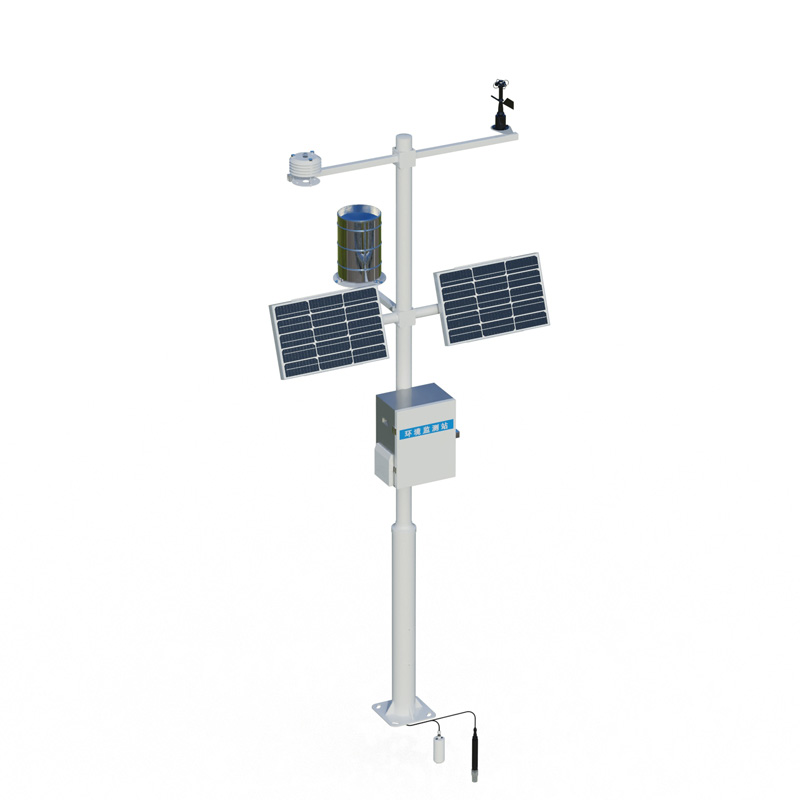
Agricultural meteorological stations is a device used for real-time monitoring of meteorological parameters in the farmland environment, including air temperature, humidity, soil moisture, soil temperature, wind speed, wind direction, rainfall, and light intensity. It features data acquisition, wireless transmission, automatic storage, threshold alarming, and data analysis functions, supporting agricultural management, pest and disease forecasting, and scientific research and teaching.
Agricultural meteorological stations is a meteorological monitoring device specifically designed for agricultural environments. The core function of this device is to continuously collect various meteorological and soil parameters in the farmland area, providing accurate localized data for agricultural production and ecological research. By deploying it in the fields, it can compensate for the insufficient spatial resolution of macroscopic weather station networks and directly reflect the specific conditions of the crop growth microenvironment. The system typically consists of a sensor unit, a data collector, a power supply module, and a communication unit. The sensor unit integrates multiple probes to measure air temperature, air humidity, soil volumetric water content, soil temperature, wind speed, wind direction, total precipitation, and photosynthetically active radiation or light intensity. These sensors convert physical quantities into electrical signals. The data collector, as the control core, collects signals from all sensors at set time intervals (e.g., every minute), performs analog-to-digital conversion and preliminary calculations, and temporarily stores the results in its internal memory. The power supply module usually uses a solar panel combined with a battery to ensure long-term stable operation in outdoor environments without mains power. The communication unit then sends the packaged data periodically or in real-time to a remote data center or cloud platform via wireless methods such as GPRS, 4G, LoRa, or satellite.
Users can access the platform via a computer webpage or mobile application to view real-time data, historical curves, and statistical reports. The system software usually sets parameter thresholds; when any monitored value exceeds the safe range (e.g., soil moisture is below the irrigation critical value), it will automatically send an alert via platform message, SMS, or email, prompting the user to intervene promptly. In addition, the software's data analysis tools can help users identify patterns of environmental change, such as accumulated temperature changes, drought trends, or meteorological conditions for disease outbreaks. In the agricultural field, the data from this station directly guides irrigation decisions, enabling on-demand water supply and saving water resources. It helps determine the timing of fertilization, avoiding nutrient loss. Monitoring data is a crucial input for predicting the occurrence and development of pests and diseases. Combined with models, it enables early warning and guides precise pesticide application. In protected agriculture, such as greenhouses, microclimate station data can be used to automatically control equipment like rolling shutters, fans, and cooling pads, optimizing the internal environment. In forestry and grassland ecological management, it is used to monitor forest fire risk levels and indicative climate factors for grassland degradation. In research and education, it provides long-term, site-specific observation data for agronomy, ecology, and meteorology research, validates crop models, and is used in practical teaching for university students.
The value of this equipment lies in transforming field management from reliance on experience to data-driven decision-making. Traditional agricultural management often relies on calendars or general intuition, while the continuous, objective data provided by microclimate stations makes decisions more scientific and precise. For example, analyzing soil temperature and moisture profile data can optimize planting depth and timing. Historical wind speed and direction records can be used to plan the optimal operating window for plant protection drones. Long-term accumulated meteorological datasets can also be used to assess the impact of climate change on local agriculture, providing a basis for variety selection and adjustments to planting systems. In practical deployment, the equipment needs to be sited appropriately according to the monitoring objectives, avoiding obstruction from buildings or trees, and ensuring that soil sensors are correctly buried in the crop root zone. Routine maintenance mainly includes cleaning the radiation sensor cover, checking the power supply status, and periodic calibration. With the development of the Internet of Things and artificial intelligence technologies, modern microclimate stations are becoming smarter, capable of edge computing, preliminary data processing, and directly outputting agricultural advice, further lowering the technical threshold for users. In short, microclimate stations, as a basic information collection terminal for smart agriculture, effectively improve resource utilization efficiency, crop yield and quality through comprehensive monitoring of environmental factors, and play an increasingly important role in ecological protection and agricultural scientific research.
The Beidou Weather Station is an independently developed automated meteorological monitoring device that integrates Beidou-3 short message communication with meteorological monitoring technology. It features autonomous operation, real-time transmission, and intelligent monitoring capabilities,...
Electric Field Detection Sensor Measurement range: -100 kV/m to +100 kV/m; Accuracy: ±0.001% F.S.; Response time: 3 seconds. Features a 6061 aluminum alloy housing, Modbus-485 communication interface, and 12 VDC power supply. It monitors atmospheric electric field variations in real-time, tri...
By integrating BeiDou-3 short-message communication with meteorological monitoring technology, these stations provide continuous, 24-hour data collection across eight key meteorological and environmental parameters. Overcoming the limitations of areas with no network or weak signals, and featu...
The Visibility Sensor is a specialized sensor device designed for automatic and continuous monitoring of atmospheric visibility, playing a vital role in fields such as meteorological observation and environmental monitoring. Its core working mechanism is based on the principle of forward scattering....


 Skype
Skype
 whatsapp
 mail
mail