Shandong Fengtu IOT Technology Co., Ltd
Sales Manager:Ms. Emily Wang
Cel,Whatsapp,Wechat:+86 15898932201
Email:info@fengtutec.com
Add:No. 155 Optoelectronic Industry Accelerator, Gaoxin District, Weifang, Shandong, China


Sales Manager:Ms. Emily Wang
Cel,Whatsapp,Wechat:+86 15898932201
Email:info@fengtutec.com
Add:No. 155 Optoelectronic Industry Accelerator, Gaoxin District, Weifang, Shandong, China
time:2026-11-05 10:12:46 source:Weather Station viewed:1 time
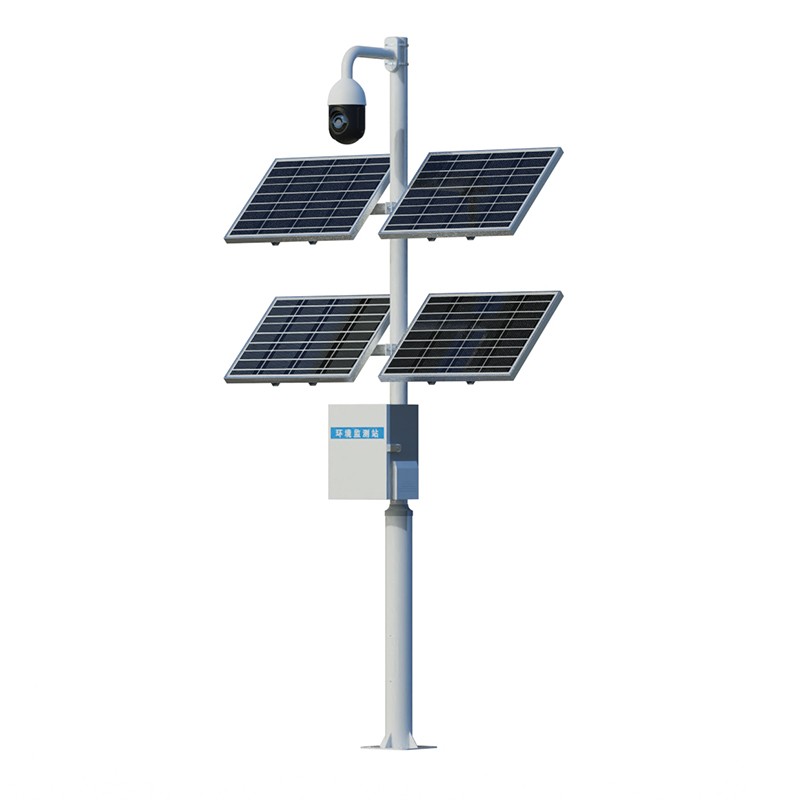
Crop monitoring equipment is a hardware system designed for remote video surveillance of agricultural fields. It consists of a 3-meter carbon steel mounting pole, a Hikvision camera, a solar power supply system, and a cloud platform. By capturing both daytime and nighttime (infrared) imagery—complemented by data from meteorological and soil moisture sensors—the system allows managers to observe crop growth and detect field anomalies without needing to physically enter the fields, providing a basis for informed decision-making regarding irrigation and pesticide application.
At the core of the system is a PTZ (pan-tilt-zoom) camera featuring 23x optical zoom and 16x digital zoom. With an infrared illumination range of up to 100 meters, it can transmit clear black-and-white footage even in total darkness. The camera offers a minimum illumination of 0.005 Lux in color mode and 0.001 Lux in black-and-white mode, effectively covering surveillance needs from dusk until late at night. The lens is equipped with built-in heating, which automatically clears fog—a common issue during seasons with significant temperature fluctuations—thereby reducing the need for manual intervention to wipe the lens. The system is powered by a combination of solar panels and rechargeable batteries, with a protective enclosure housing the controller and battery units. The mounting pole can be secured along field boundaries or roadsides, making it ideal for large, contiguous agricultural areas where access to a power grid is difficult.
In terms of functionality, the primary purpose of the equipment is to provide visibility. Features such as regional intrusion detection and line-crossing detection are used to monitor for unauthorized entry—such as agricultural machinery straying into the wrong area, livestock intrusion, or nighttime theft—triggering automatic image capture and alerts whenever a moving object enters a predefined zone. Scheduled image capture and automated patrol functions facilitate the documentation of crop development; managers can set the system to take photos at specific times each day, archiving them by date to track changes in plant height or leaf color. The system utilizes "triple-stream" technology, allowing a single video feed to be output at multiple resolutions simultaneously: a low-bitrate stream for quick viewing on mobile devices, and a high-bitrate stream for detailed retrospective analysis.
The cloud platform serves as the hub for data aggregation and remote access. After logging in via a web browser or mobile app, users can view real-time footage, historical snapshots, and the online status of their devices—all from a single interface. The platform supports threshold-based alerts; for instance, if a device remains offline beyond a set duration, or if a camera’s view becomes abnormally obstructed, the system will automatically send an SMS notification to a designated mobile number. A data export feature also allows agricultural technicians to download batches of snapshots from specific periods, which can then be used to compile crop growth records or submit reports to higher authorities.
Experience from various regions shows that the primary value of crop monitoring equipment lies in shifting field inspection from a process of "physically walking the fields" to one of "checking on demand." At the Xiaozhan Rice demonstration base in Tianjin, the crop monitoring module has been integrated into an IoT network alongside systems for tracking pest activity and soil moisture; technicians can simply enter commands at a computer to retrieve data on crop growth in specific plots. Similarly, a smart farm in Taishan, Jiangmen, has incorporated crop monitoring into a centralized "four-factor" (crop, pest, soil moisture, and disaster) monitoring dashboard, enabling managers to decide—based on visual evidence—whether to schedule additional fertilization or plant protection measures. For agricultural operations covering large areas with limited personnel, video monitoring provides an intuitive visual perspective, reducing the time and travel costs associated with frequent field visits while offering a valuable, visual reference for decision-making during critical stages of crop development.
It is feasible to use soil moisture monitoring system to guide agricultural irrigation. Soil moisture monitoring systems can monitor soil moisture, temperature, conductivity and other parameters in real time to help farmers understand the soil condition of farmland in time and provide scientific bas...
Specifically developed for monitoring the local meteorological environment along transmission tower corridors, the system collects parameters such as wind speed, wind direction, temperature, humidity, air pressure, and rainfall in real time. This data is transmitted to the monitoring center vi...
For a long time, agricultural production has largely relied on experience and the observation of the weather. When it comes to sowing, irrigation and dealing with extreme weather conditions, decisions often depend on traditional wisdom passed down orally. Nowadays, agricultural meteorological statio...
In the modern transportation system, tunnels are important transportation infrastructure, playing a role in connecting different regions and promoting smooth traffic. However, the space inside tunnels is relatively enclosed, with heavy and complex traffic flow. Vehicle exhaust emissions, smoke parti...




 Skype
 whatsapp
 mail