Shandong Fengtu IOT Technology Co., Ltd
Sales Manager:Ms. Emily Wang
Cel,Whatsapp,Wechat:+86 15898932201
Email:info@fengtutec.com
Add:No. 155 Optoelectronic Industry Accelerator, Gaoxin District, Weifang, Shandong, China


Sales Manager:Ms. Emily Wang
Cel,Whatsapp,Wechat:+86 15898932201
Email:info@fengtutec.com
Add:No. 155 Optoelectronic Industry Accelerator, Gaoxin District, Weifang, Shandong, China
time:2026-11-04 10:05:50 source:Weather Station viewed:1 time
The core of a lightning early warning system lies in its electric field detection mechanism. Based on the principle of charge induction and developed using Micro-Electro-Mechanical Systems (MEMS) technology, this fully digital electric field detection and lightning early warning platform eliminates the need for motors or other moving mechanical parts prone to wear. It offers advantages such as compact size, low power consumption, high reliability, and ease of integration. By combining electric field differentiation with threshold-based logic, the system optimizes its warning algorithms; compared to conventional methods that rely solely on fixed thresholds, this approach significantly reduces false alarms caused by environmental factors—such as rain, high winds, snow, or airborne dust—thereby improving warning accuracy. Designed for precise, localized, short-term lightning forecasting, the system is easy to install and network. It is primarily intended for atmospheric electric field monitoring and lightning warning applications in sectors including aerospace and national defense, meteorology, the oil and petrochemical industry, power grids, tourist attractions, mining, fuel depots, and military operations. The system features an electric field measurement range of -100 kV/m to +100 kV/m, a resolution of 0.1 V/m, and an accuracy of ±0.001% of full scale (F.S.). It has a detection radius of 15 km, a total unit weight of 35 kg (with the sensor weighing 710 g), and operates on a 12V DC power supply.
MEMS-based electric field sensing has reached the stage of practical application in meteorological equipment. Certain lightning warning systems utilizing this technology have received official certification for meteorological use and have been deployed in locations such as chemical industrial parks and launch sites. These systems address the critical need for timely, localized, short-term lightning warnings, providing a necessary lead time for personnel evacuation and the shutdown of sensitive equipment. Unlike traditional "field mill" sensors, which contain rotating components that suffer from mechanical wear and require ongoing maintenance during long-term outdoor operation, the MEMS-based solution replaces motor-driven parts with micro-mechanical structures. The sensor weighs only about 710 grams, which simplifies installation and deployment within a sensor network.
At the algorithmic level, the system incorporates electric field differentiation, factoring the rate of change in the electric field—generated by thunderclouds—into its decision-making criteria, rather than relying exclusively on a single, static threshold to trigger an alert. Baseline drift in the electric field caused by rain, or transient disturbances from wind-blown dust, cannot always be directly translated into a reliable early warning signal. With a 15-kilometer detection radius, the system provides an effective buffer for locations such as oil depots and tourist attractions, capturing the critical time window between the approach of a thundercloud and the actual onset of lightning. The lightning early warning system supports cloud-based data transmission and a three-level audible and visual alarm mechanism; this eliminates the need for on-site personnel to constantly monitor a screen, as the alarm triggers can be seamlessly integrated into existing safety protocols.
During deployment, it is essential to ensure that sensors are installed away from high-voltage lines and physical obstructions; proper grounding and installation during fair-weather conditions are also fundamental requirements. For facilities requiring a multi-point sensor network, the lightweight, low-power design of the sensors reduces the engineering burden associated with mounting structures and power supply—with solar-powered options available for remote, off-grid locations. The system is designed for sectors such as aerospace and defense, meteorology, the oil and petrochemical industry, power grids, tourist sites, mining, oil storage facilities, and military operations—all of which have a high demand for atmospheric electric field monitoring and localized, short-term lightning early warnings.
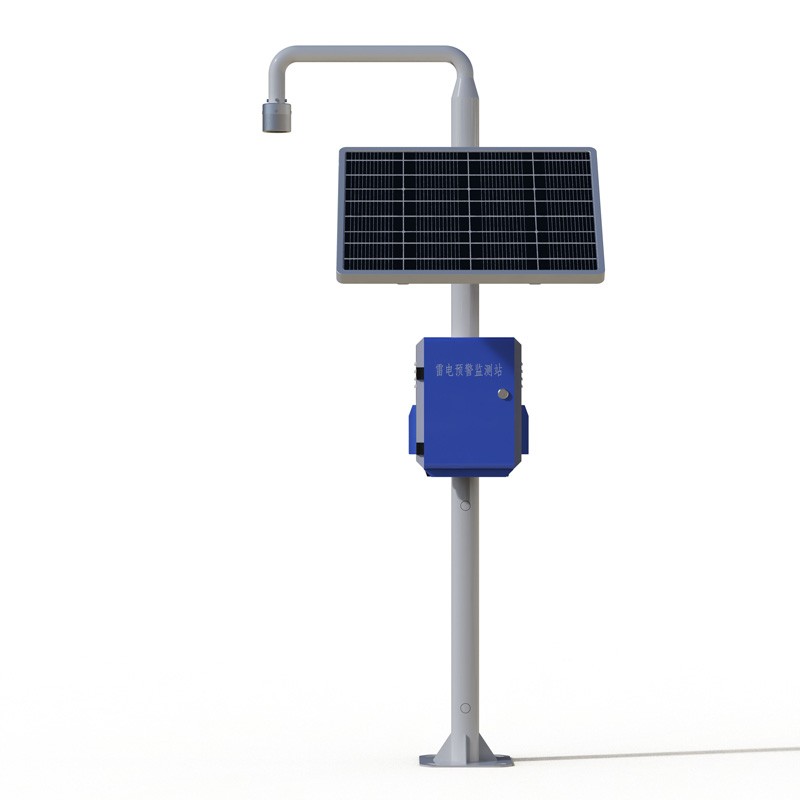
Electric Field Detection Sensor Measurement range: -100 kV/m to +100 kV/m; Accuracy: ±0.001% F.S.; Response time: 3 seconds. Features a 6061 aluminum alloy housing, Modbus-485 communication interface, and 12 VDC power supply. It monitors atmospheric electric field variations in real-time, tri...
This crop growth monitoring equipment is an automated agricultural monitoring system. It uses a high-definition camera to collect real-time daytime and nighttime infrared images of crop growth and development. Combined with meteorological and soil moisture sensors and pest forecast lights, it...
The UAV Visibility Meter is a high-precision optical device integrated into an unmanned aerial vehicle (UAV) platform, operating on the principle of forward scattering. The instrument emits infrared light beams of specific wavelengths and accurately measures the scattered light intensity of airborne...
Specifically developed for monitoring the local meteorological environment along transmission tower corridors, the system collects parameters such as wind speed, wind direction, temperature, humidity, air pressure, and rainfall in real time. This data is transmitted to the monitoring center vi...


 Skype
 whatsapp
 mail