Shandong Fengtu IOT Technology Co., Ltd
Sales Manager:Ms. Emily Wang
Cel,Whatsapp,Wechat:+86 15898932201
Email:info@fengtutec.com
Add:No. 155 Optoelectronic Industry Accelerator, Gaoxin District, Weifang, Shandong, China


Sales Manager:Ms. Emily Wang
Cel,Whatsapp,Wechat:+86 15898932201
Email:info@fengtutec.com
Add:No. 155 Optoelectronic Industry Accelerator, Gaoxin District, Weifang, Shandong, China
time:2026-06-12 13:18:39 source:Weather Station viewed:123 time
Specifically developed for monitoring the local meteorological environment along transmission tower corridors, the system collects parameters such as wind speed, wind direction, temperature, humidity, air pressure, and rainfall in real time. This data is transmitted to the monitoring center via GPRS or fiber optic cable, and warning SMS messages are automatically sent.
The online monitoring system is a multi-element monitoring device specifically designed for monitoring the local meteorological environment along transmission line corridors. It primarily collects key meteorological parameters such as wind speed, wind direction, ambient temperature, relative humidity, atmospheric pressure, and rainfall around the transmission towers in real time. This data is then transmitted to a remote monitoring center for analysis and processing via wireless network or fiber optic cable. This system typically consists of three parts: a monitoring unit, a communication base station, and an analysis and query system. The monitoring unit is installed on the power transmission tower, with the specific installation location selectable according to the customer's actual needs. The communication base station and analysis system are deployed at the monitoring center, responsible for data reception, storage, and intelligent analysis.
In terms of data acquisition, the system integrates a high-precision sensor array, enabling real-time acquisition of micro-meteorological changes within the transmission line area. This high-frequency, multi-dimensional meteorological data plays a crucial role in assessing the stability of the line's operating environment. At the communication transmission level, the system supports multiple communication methods, primarily including GPRS, 3G, 4G, and fiber optic wireless transmission technologies. For remote mountainous areas without mobile signals, wireless relay can be used to transmit signals to poles with signals before long-distance transmission back.
After monitoring data is sent to the monitoring software and database on a remote server, the monitoring center not only performs curve statistics and visualization of the data but also dynamically compares it with set warning thresholds. If any meteorological parameter exceeds the safe range, the system immediately sends warning messages to designated personnel via SMS, ensuring that maintenance personnel are aware of the anomaly and can take appropriate measures immediately. In terms of power supply, the device primarily uses solar panels in conjunction with battery banks for continuous power. The power management module strictly controls the charging and discharging process according to the battery characteristics, enabling long-term stable operation in harsh weather conditions. Some systems also integrate low-power technology and multi-layer electromagnetic protection design to adapt to various complex environments.
By automatically collecting meteorological data around the clock and enabling intelligent early warning, the system significantly reduces the labor intensity of manual inspections and provides reliable data support for power transmission line condition assessment, disaster prevention and mitigation, and safe operation of the power grid.
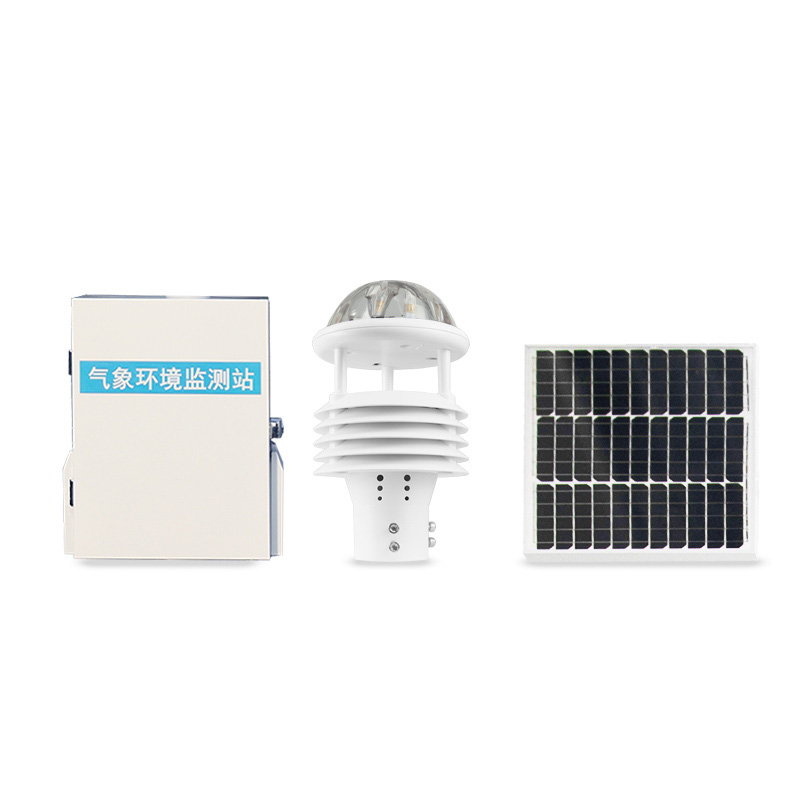
This lightning monitoring and early warning system is a fully digital platform for electric field detection and warning. It utilizes MEMS charge-sensing probes and employs an optimized differential electric field algorithm to minimize false alarms caused by rain, snow, or airborne dust. Suppor...
Environmental Monitoring Station captures the concentration of negative oxygen ions in the air around the clock, relying on IoT technology to provide data support for environmental health and ecological value....
This integrated mini weather station is a high-precision automatic meteorological observation device. It integrates ten meteorological sensors, features low power consumption and easy installation, supports multiple data transmission methods, and can continuously monitor meteorological environ...
Grassland Meteorological Environment Monitoring System is a device used to monitor and record grassland meteorological elements. It can observe multiple meteorological elements in real time, employs technology adapted to the grassland environment, supports long-term unattended operation, and d...


 Skype
Skype
 whatsapp
 mail
mail