Shandong Fengtu IOT Technology Co., Ltd
Sales Manager:Ms. Emily Wang
Cel,Whatsapp,Wechat:+86 15898932201
Email:info@fengtutec.com
Add:No. 155 Optoelectronic Industry Accelerator, Gaoxin District, Weifang, Shandong, China


Sales Manager:Ms. Emily Wang
Cel,Whatsapp,Wechat:+86 15898932201
Email:info@fengtutec.com
Add:No. 155 Optoelectronic Industry Accelerator, Gaoxin District, Weifang, Shandong, China
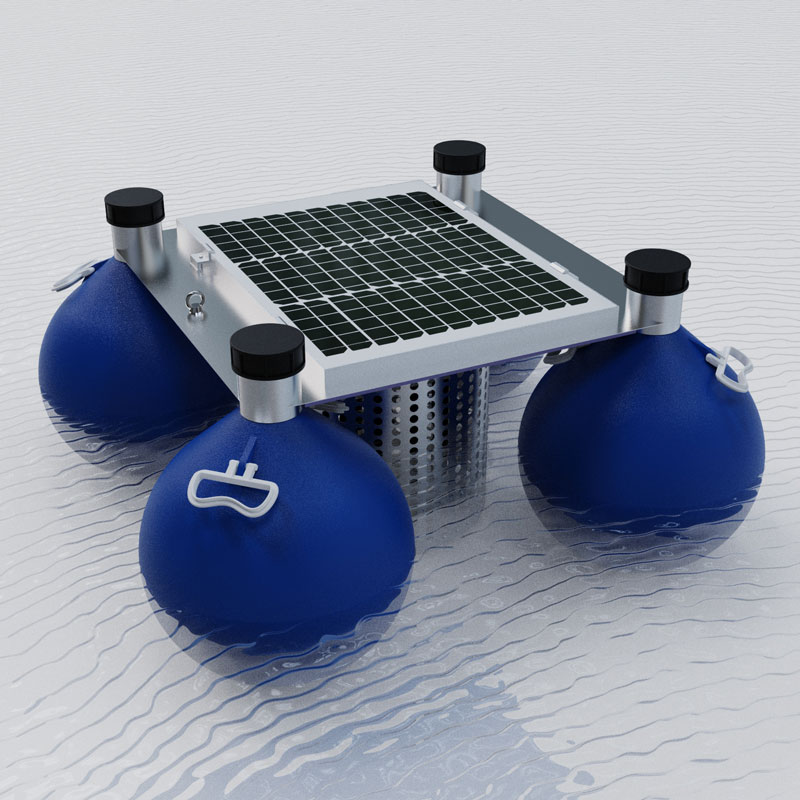
Model:FT-SFA04
Brand:fengtu
1.Introduction to Water Monitoring Buoy Systems
1. The water quality floating monitoring station SFA is an unattended data collection system that integrates data collection, storage, transmission and management. It is an automatic hydrological monitoring and reporting system for industrial and agricultural production, tourism, urban environmental monitoring, geological disasters, flood control, water supply scheduling, power station reservoir water management, etc. The powerful host computer software can remotely observe real-time water and rainfall information, and has database, report, download and other functions. Users can also use the well-functioning meteorological software to further process and analyze the recorded data.
2. The SFA04 buoy is composed of six parts: water quality sensor (water temperature, conductivity, PH, dissolved oxygen), data acquisition instrument, communication system, power supply system, overall bracket, and water quality monitoring platform. At the same time, it can expand multiple water quality elements such as ammonia nitrogen, turbidity, COD, etc. The data acquisition instrument has data acquisition, real-time clock, data timing storage, parameter setting and standard 2G/4G (GPRS) communication functions.
2. Features of Water Monitoring Buoy Systems
1. Easy to deploy: various types of probes are highly integrated and easy to install; free cloud platform services are provided, and the system can be quickly put online;
2. Easy maintenance: After the equipment is installed, it can work automatically without manual supervision. The normal operation of the equipment can also be ensured by remote monitoring;
3. Easy to expand: sensor probes all use a unified communication protocol, which can quickly connect to the original equipment and quickly expand monitoring parameters;
4. Low power consumption: The device can run for a long time in a low power consumption state, increasing the convenience of device use;
5. Real-time: The data monitored by the equipment is transmitted to the cloud platform in real time to improve the timeliness of environmental data feedback.
3. Technical Parameters of Water Monitoring Buoy Systems
1. Subject parameters
| product name | describe |
| Water Monitoring Buoy Systems |
Real-time online monitoring of multiple parameters can be achieved. Battery charge monitoring can be realized. It can realize cloud platform data monitoring, data push, Data storage and alarm function; data wireless transmission function. The peak power consumption is 5W; the sensor power consumption is about 0.25W per sensor. Overall dimensions: 750mm*750mm*535mm. Float diameter 414mm Weight: 22kg |
| Collector data collection | Reliable operation, anti-interference, can integrate multiple RS485/MODBUS-RTU slave devices |
| Collector data output | 1 channel RS485/JSON protocol output |
| Battery | Lithium battery 12VDC, 20AH (default) |
| solar panel | 22.1V/50W (default) |
| Power supply capability | Customized selection; intermittent operation for more than 5 days on rainy days |
| Position indicator (optional) | Warning light;GPS positioning; |
| Monitoring Platform | Cloud platform; mobile phone/computer multi-terminal login |
| protecting mask | 304 stainless steel filter cartridge protective cover |
| Floating body | Diameter 414mm, spherical float * 4 engineering plastics |
2. Main parameters of optional sensors
| Model | Name | Measurement range | Principle | Measurement accuracy | Resolution | Is it standard equipment | Note |
| S3 | pH | 0~14 (ph) | Electrochemistry (salt bridge) | ±0.1PH;±0.1℃ | 0.01 | √ | With warm supplement |
| S7 | Electrical conductivity | 0~10000uS/cm | Contact method of electrode | ±1.5%; ±0.1°C | 1uS/cm | √ | With warm supplement |
| S8 | Dissolved oxygen | 0~20mg/L | Fluorescence lifetime method | ±2%, ±0.3℃ | 0.01mg/L | √ | With warm supplement |
4. Water Monitoring Buoy Systems Product Dimensions
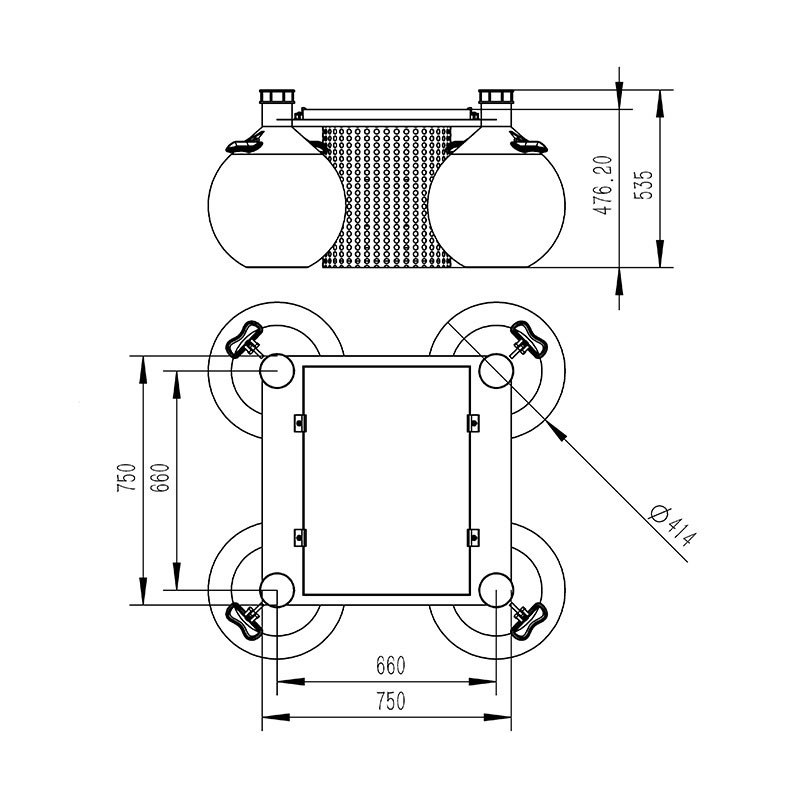
5. Water Monitoring Buoy Systems Equipment Installation Requirements
1. Stay away from high-power radio transmitters
2. Stay away from high-voltage transmission lines and microwave radio transmission channels
3. Try to be close to the data transmission network
4. Stay away from strong electromagnetic interference
6. Introduction to Water Monitoring Buoy Systems Cloud Platform
1.CS architecture software platform, supports direct observation via mobile phone and PC browser. No additional software installation is required.
2.Support multiple accounts and multiple devices login
3. Support real-time data display and historical data display dashboard
4. Cloud server. Cloud data storage, stable and reliable, easy to expand, and load balanced.
5.Support SMS alarm and threshold setting
6.Support map display and view device information.
7.Support data curve analysis
8.Support data export in table format
9.Support data forwarding, HJ-212 protocol, TCP forwarding, http protocol, etc.
10. Support data post-processing function
11.Support external running of javascript scripts
Atmospheric light transmittance refers to the ratio of the light intensity after light propagates through gases, aerosols, particulate matters and other substances in the atmosphere to the incident light intensity. Measuring the atmospheric light transmittance is of great significance for the transp...
Intelligent transportation utilizes new-generation information technologies such as the Internet of Things and cloud computing, along with theoretical tools like transportation science and artificial intelligence, aiming to achieve comprehensive perception and scientific decision-making. By building...
Plant Growth Monitoring facilitates real-time monitoring of crop growth and development, pest and disease outbreaks, and disaster conditions through both daytime and nighttime infrared video feeds. By integrating meteorological sensors, soil moisture sensors, and pest forecasting lamps, the sy...
A rain gauge is an important device used to measure precipitation. With the continuous advancement of science and technology, the types of rain gauges have become increasingly diverse, among which the piezoelectric rain gauge has emerged as a "new favorite" in the market in recent years. B...


 Get a Free Quote
 Skype
Skype
 whatsapp
 mail
mail