Shandong Fengtu IOT Technology Co., Ltd
Sales Manager:Ms. Emily Wang
Cel,Whatsapp,Wechat:+86 15898932201
Email:info@fengtutec.com
Add:No. 155 Optoelectronic Industry Accelerator, Gaoxin District, Weifang, Shandong, China


Sales Manager:Ms. Emily Wang
Cel,Whatsapp,Wechat:+86 15898932201
Email:info@fengtutec.com
Add:No. 155 Optoelectronic Industry Accelerator, Gaoxin District, Weifang, Shandong, China
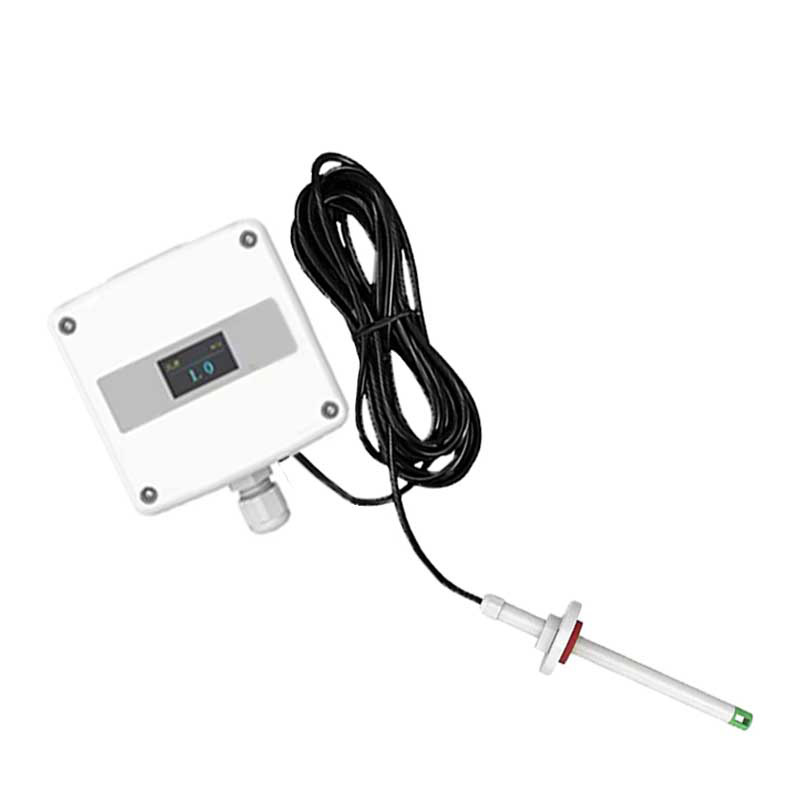
Model:FT-GFS2
Brand:fengtu
Device Name: Duct Type Wind Speed Sensor
Functional description: Designed for pipeline wind speed measurement, the independently developed high-precision wind speed measurement unit is sensitive and can quickly and accurately measure small wind speeds, with good stability, small drift and high accuracy. The transmitter can also calculate the real-time air volume value according to the set measured pipeline cross-sectional area.
Detection principle: The wind speed is measured using the hot wire balance principle. The response speed is fast and the starting wind speed is small.
Calibration method: The full-range secondary calibration method independently developed by the company is adopted, which has good linearity and high accuracy;
Wiring method: The terminal block adopts military-grade spring-type screw-free terminal, which can be connected by pressing and plugging. Even if there is no screwdriver on site, the wire can be quickly connected. It can adapt to wire diameters of 0.3 to 2.0 mm2
Duct Type Wind Speed Sensor Installation Notes:
①. Open-hole flange installation, using high-quality silicone sealing ring, small air leakage, durable;
②. Note that it needs to be installed on the side or bottom of the pipe, and cannot be installed from top to bottom.
③. First, make a hole with a diameter of 20mm on the ventilation duct, insert the air duct into the hole, and adjust the direction of the equipment so that the arrow direction of the equipment is consistent with the direction of the wind speed (the direction from which the wind comes). The height of the equipment can be controlled by adjusting the position of the flange.
Measurement elements: ①, real-time duct wind speed; ②, RS485 type optional duct air volume value;
Signal output: RS485, 4-20ma, 0-5v, 0-10v
Parameter modification: ①. The device address and baud rate can be changed and the pipe cross-sectional area can be set through 485 commands; ②. The 485 type can provide professional configuration tools to configure device parameters; ③. The 485 type can adjust the 485 slave station through the hardware DIP switch.
Probe line length: The default line length is 1m, which can be longer or shorter. The longest length can be 100m, but there needs to be no interference around the line.
The Duct Type Wind Speed Sensor device displays:
①. Optional organic light-emitting display, OLED screen with wider viewing angle, self-luminous and low power consumption.
②, Model 485 can display the current wind speed and related wind volume in rotation.
③. The analog type can display the current range and current wind speed in rotation.
Power supply: 10-30V DC
Maximum power consumption: 0.5W
Measuring medium: air, nitrogen, oil fume exhaust gas
Accuracy: The accuracy of the measuring range 0~10m/s is ±(0.1+2%FS); the accuracy of the measuring range 0~15m/s, 0~20m/s, 0~30m/s is ±(0.2+2%FS)m/s;
Circuit operating temperature: -10℃~+50℃
Wind speed display resolution: 0.1m/s
Response time: 2S
Long-term stability: ≤0.1m/s/year
Park weather station monitors elements such as temperature, humidity, and wind speed, serving the ecological management, visitor safety, and scientific research of scenic areas....
Lightning monitor is a high-precision lightning monitoring and early warning device with a measurement range of -100kV/m to 100kV/m, a 3-second fast response, and transmits electric field monitoring data via Modbus-485. It provides reliable monitoring support for lightning risk prevention and...
When the fog is thick, it is particularly difficult to navigate ships in places like the Huangpu River where the waterway is narrow and the navigation conditions are complex. Due to the heavy fog, the pilots can hardly see the ships in the distance and the objects on the shore. At this time, relying...
The FT-BN20 Portable Visibility Detector is a precision instrument designed using the forward scattering principle, which automatically calculates current visibility values by measuring the total air extinction coefficient. With a maximum range of 20 kilometers, this device meets the precise visibil...


 Get a Free Quote
 Skype
Skype
 whatsapp
 mail
mail