Shandong Fengtu IOT Technology Co., Ltd
Sales Manager:Ms. Emily Wang
Cel,Whatsapp,Wechat:+86 15898932201
Email:info@fengtutec.com
Add:No. 155 Optoelectronic Industry Accelerator, Gaoxin District, Weifang, Shandong, China


Sales Manager:Ms. Emily Wang
Cel,Whatsapp,Wechat:+86 15898932201
Email:info@fengtutec.com
Add:No. 155 Optoelectronic Industry Accelerator, Gaoxin District, Weifang, Shandong, China
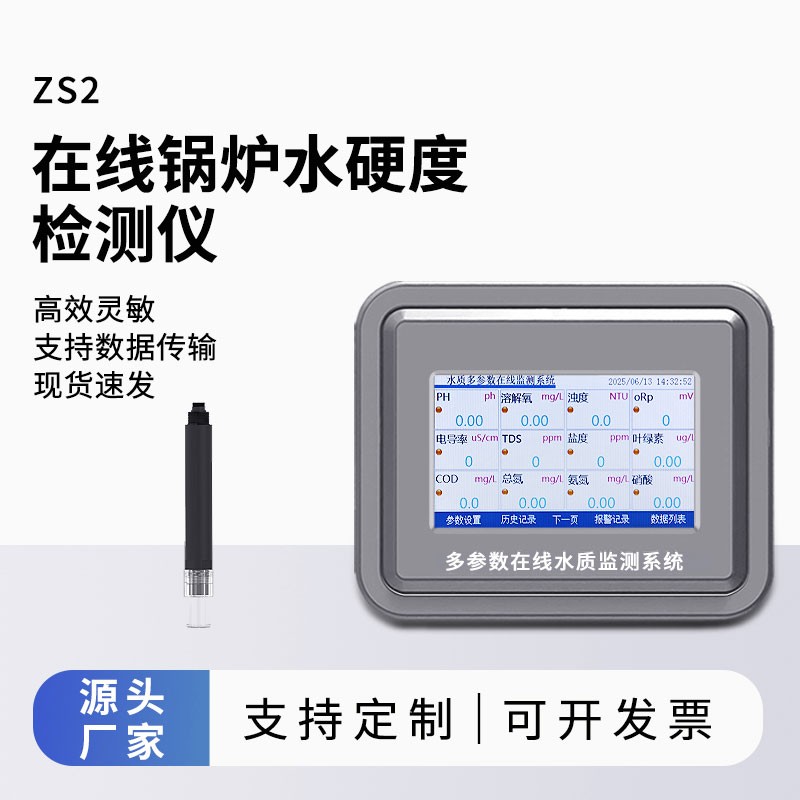
Model:FT-ZS2
Brand:fengtu
1、Water Hardness Analyzer Product Introduction
The Water Hardness Analyzer is an instrument designed for the online monitoring of water hardness, capable of rapidly and accurately recording key water quality parameters. It supports the integration of additional multi-parameter water quality sensors, allowing for flexible configurations tailored to specific needs and applications; it records and stores historical monitoring data and alarm logs, and supports data export. Equipped with an RS485 interface supporting the Modbus-RTU protocol, it facilitates seamless communication and data transmission with devices such as PLCs, DCS systems, SCADA/HMI software, and DTUs.
2、Water Hardness Analyzer Application Areas
Water Hardness Analyzer is widely used for monitoring various types of water bodies, including but not limited to the following areas:
1. Water Treatment Plants: Used to monitor parameters such as pH, dissolved oxygen, and turbidity to ensure the safety and hygiene of the water supply.
2. Groundwater Monitoring: Used to monitor parameters such as pH, electrical conductivity, and temperature, enabling the timely detection and resolution of water quality issues.
3. River and Lake Monitoring: Used to monitor water quality parameters—such as dissolved oxygen, turbidity, and ammonia nitrogen—in rivers and lakes, facilitating timely pollution control measures.
4. Marine Monitoring: Used to monitor marine water quality parameters—such as salinity, dissolved oxygen, and temperature—to detect and control marine pollution in a timely manner.
5. Wastewater Treatment: Used to monitor wastewater quality parameters—such as pH, COD, and ammonia nitrogen—to control and regulate the treatment process.
6. Industrial Production: Used to monitor water quality during industrial processes (e.g., pH, conductivity, dissolved oxygen), allowing for timely process adjustments to ensure product quality.
7. Scientific Research: Used for water quality monitoring in scientific research, such as studies on lake eutrophication and climate change.
3、Water Hardness Analyzer Product Features
1. High Reliability: Suitable for long-term field operation; offers stable measurements and strong interference resistance.
2. Flexible and Portable: Probes can be freely combined and independently replaced; features plug-and-play functionality.
3. Expandability: Supports flexible combinations of various sensors.
4. Versatile Applications: Suitable for rapid on-site testing, emergency monitoring, and long-term online monitoring of groundwater, river water, lake water, and municipal pipeline water.
5. Rugged Housing: Made of ABS+PC material; corrosion-resistant and capable of continuous, reliable operation over extended periods.
6. Compact Design: Suitable for installation in space-constrained environments.
7. Communication Connectivity: Features an RS485 expansion interface with isolated master/slave ports for independent communication.
4、Water Hardness Analyzer Technical Specifications
| Display Output | 4.3-inch touchscreen with LED backlight, operable in direct sunlight. |
| Power supply | DC Power Supply: DC12V |
| Power consumption | Instrument power consumption is about 12V/1W. |
| Sound output | Buzzer |
| Communication Protocol | Standard RS485 Modbus-RTU protocol and device master/slave transmission channel support |
| Main materials | ABS+PC material |
| Storage temperature | -20 to 70℃ |
| Operating temperature | -10 to 50°C |
| Protection rating | IP65 |
| Size | 175mm*140mm*49mm (Length × Width × Height) |
| Weight | Approximately 0.5KG |
5、Water Hardness Analyzer Sensor Parameters
| Model | Name | Measurement Range | Principle | Measurement accuracy | Resolution | Is it standard? |
| S2 | Water hardness | 0~1000mg/L (as Ca) | Contact electrode indirect measurement method | ±10% (water hardness); ±0.1°C (temperature) | 0.1mg/L | √ |
In the modern transportation system, accurately grasping traffic conditions is crucial for ensuring travel safety and improving traffic efficiency. This relies on a series of advanced instruments, among which Weather Visibility Sensors, Road Condition Sensors, and Laser-based Snow Depth Sensors help...
The 50KM Visibility sensor is a measuring instrument in industries such as road traffic and meteorology. It uses the forward scattering method to measure the total extinction coefficient of the air and thus obtain accurate visibility data.This sensor uses an aluminum shell, which is anodized and pai...
Tunnels are enclosed spaces with poor air circulation, and due to complex traffic structures and heavy traffic volumes, poor ventilation can easily lead to the accumulation of harmful gases such as smoke particles and carbon monoxide (CO). This significantly reduces visibility inside the tunnel and...
In modern meteorological monitoring, while traditional fixed weather stations have established basic monitoring networks, they often fall short in responding to sudden weather events, remote area monitoring, and temporary meteorological services. With the intensification of climate change and freque...


 Get a Free Quote
 Skype
 whatsapp
 mail