Shandong Fengtu IOT Technology Co., Ltd
Sales Manager:Ms. Emily Wang
Cel,Whatsapp,Wechat:+86 15898932201
Email:info@fengtutec.com
Add:No. 155 Optoelectronic Industry Accelerator, Gaoxin District, Weifang, Shandong, China


Sales Manager:Ms. Emily Wang
Cel,Whatsapp,Wechat:+86 15898932201
Email:info@fengtutec.com
Add:No. 155 Optoelectronic Industry Accelerator, Gaoxin District, Weifang, Shandong, China
time:2026-03-20 10:55:49 source:Weather Station viewed:285 time
Transmission Line Online Monitoring System was developed specifically to address the localized meteorological environments within transmission line corridors. Designed for installation on power transmission towers, it is capable of monitoring six key meteorological parameters in real-time: wind speed, wind direction, temperature, humidity, atmospheric pressure, and piezoelectric precipitation. By utilizing high-precision sensors to collect data, the system provides essential real-time meteorological support to ensure the safe operation of transmission line corridors under various environmental conditions.
Transmission Line Online Monitoring System is a specialized micro-meteorological monitoring device designed for installation on power transmission towers, primarily focused on the real-time data acquisition of local weather conditions within transmission line corridors. The system integrates six distinct sensing units—covering wind speed, wind direction, air temperature, air humidity, atmospheric pressure, and piezoelectric precipitation—enabling the continuous monitoring of meteorological parameters along the transmission line corridor across a wide range of environmental conditions.
Wind speed measurement is based on ultrasonic principles, featuring a measurement range of 0 to 60 meters per second with an accuracy of ±0.1 m/s. Wind direction measurement covers a full 360-degree range with no blind spots, offering an accuracy of ±2 degrees. Air temperature is measured within a range of -40°C to +60°C, with an accuracy of ±0.3°C. Air humidity measurement covers the full range of 0% to 100% relative humidity, with an accuracy of ±3% RH. Atmospheric pressure is measured within a range of 300 to 1100 hPa, with an accuracy of ±0.25%. Piezoelectric precipitation measurement monitors rainfall intensity ranging from 0 to 4 mm per minute, with a measurement error not exceeding ±4%. These technical specifications meet the fundamental requirements for data accuracy in the micro-meteorological monitoring of transmission lines.
The system operates by utilizing an array of meteorological sensors—typically installed on the crossarms of the transmission tower—to collect environmental data in real-time. This data is processed and packaged by a dedicated data processing unit, then transmitted to a remote monitoring center via a wireless communication module. The monitoring platform stores, displays, and intelligently analyzes the received meteorological information; should any monitored value exceed a pre-configured threshold, the system triggers a warning alert, thereby assisting operations and maintenance personnel in promptly identifying and responding to changing weather trends along the transmission line corridor.
Power supply is typically provided via solar panels paired with a battery bank. Operating at an input voltage of 12V DC, the system maintains a low power consumption profile to ensure reliable, long-term operation in remote outdoor environments. The device features an overall protection rating of IP65 or higher, with an operating temperature range spanning from -40°C to +85°C, enabling it to operate continuously and stably under various harsh climatic conditions—including extreme cold, high temperatures, and high humidity.
Transmission lines are often widely distributed across complex terrains, such as mountains and valleys, where their safe operation is significantly influenced by localized micro-meteorological fluctuations. Traditional weather stations are typically spaced far apart, making it difficult to capture small-scale, sudden meteorological changes occurring within the transmission corridor; furthermore, data collected by single sensors offers limited dimensionality, resulting in delays in issuing warnings for hazards such as ice accumulation and strong winds. By deploying an online monitoring system directly onto transmission towers, operators can achieve real-time situational awareness of temperature, humidity, wind speed and direction, and rainfall levels within the line corridor, thereby assisting operations and maintenance personnel in proactively identifying and understanding the specific meteorological characteristics of localized micro-climate zones.
In terms of practical application, this system has already been deployed by power utility companies across numerous regions, providing essential data support for the proactive defense of transmission lines during adverse weather events. By integrating high-precision sensors with intelligent early-warning algorithms, the system empowers field personnel to precisely identify high-risk line segments and implement preventive measures in advance, thereby effectively mitigating the risk of faults such as wind-induced conductor flashovers and phase-to-phase short circuits caused by conductor collisions.
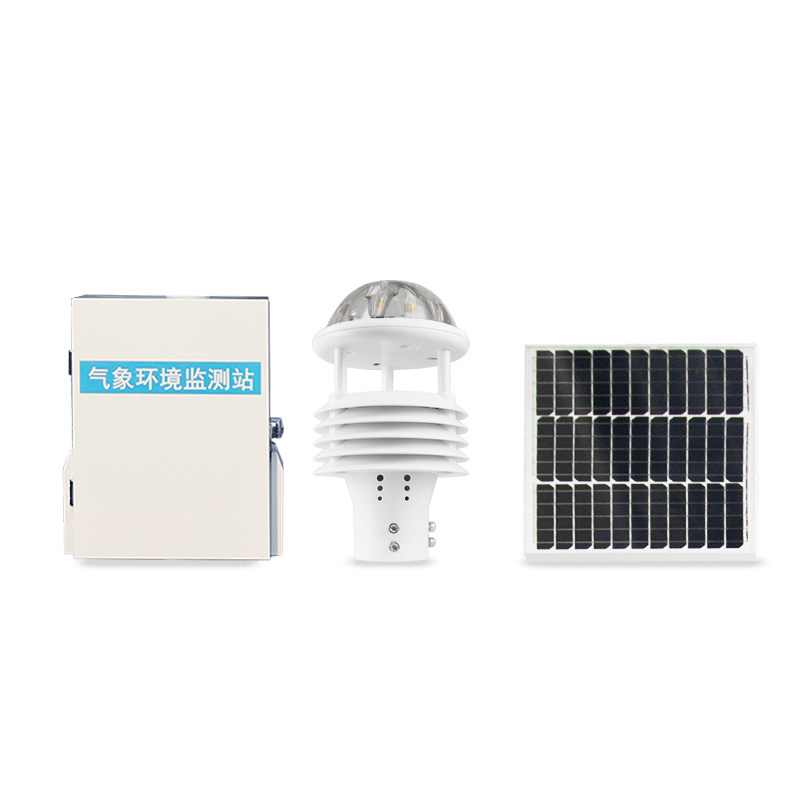
The transmission line micro-meteorological online monitoring system is an industrial-grade meteorological monitoring device installed on power transmission towers. It uses a high-precision sensor array to collect meteorological parameters such as wind speed, wind direction, temperature, humidi...
A Portable Weather Station is a highly integrated, easy-to-carry, and rapidly deployable automated meteorological observation device. It can provide real-time, accurate local meteorological data in areas not covered by traditional fixed weather stations, serving as a "take-anywhere" mini w...
Tea garden insect traps utilize solar power and a wind-suction mechanism. By employing LED light sources of specific wavelengths, they lure pests to fly toward the device; a fan then generates a negative-pressure airflow that draws the pests into a collector, where they are desiccated through...
Portable Weather Station is a highly integrated, portable, and rapidly deployable automatic weather observation device. It incorporates sensors, a data logger, a power supply system, and a communication module into a compact housing or mast. Its core features can be summarized as "portable, rap...


 Skype
Skype
 whatsapp
 mail
mail