Shandong Fengtu IOT Technology Co., Ltd
Sales Manager:Ms. Emily Wang
Cel,Whatsapp,Wechat:+86 15898932201
Email:info@fengtutec.com
Add:No. 155 Optoelectronic Industry Accelerator, Gaoxin District, Weifang, Shandong, China


Sales Manager:Ms. Emily Wang
Cel,Whatsapp,Wechat:+86 15898932201
Email:info@fengtutec.com
Add:No. 155 Optoelectronic Industry Accelerator, Gaoxin District, Weifang, Shandong, China
time:2026-04-16 11:42:43 source:Weather Station viewed:285 time
Designed specifically for the localized meteorological environment within transmission line corridors, the Transmission Line Micrometeorology Online Monitoring System monitors parameters such as wind speed, wind direction, temperature, humidity, atmospheric pressure, and rainfall in real time. The system utilizes solar power and 4G wireless transmission, providing early warning capabilities for potential safety hazards such as icing and strong winds.
The Transmission Line Micrometeorology Online Monitoring System is an industrial-grade, multi-parameter micrometeorological monitoring system engineered for the specific purpose of monitoring local weather conditions within transmission line corridors. Its primary function is to provide real-time surveillance of meteorological parameters—including wind speed, wind direction, temperature, humidity, atmospheric pressure, and rainfall—within the line's operational area. The system is capable of precisely identifying potential safety hazards along the transmission lines, such as areas prone to icing or zones subject to strong winds. Powered by a combination of solar panels and backup batteries, the system transmits real-time monitoring data back to a central monitoring center via 4G or 5G wireless networks, thereby enabling continuous, 24-hour online monitoring.
In terms of hardware composition, the Transmission Line Micrometeorology Online Monitoring System typically consists of an integrated multi-parameter meteorological sensor unit, a data acquisition unit, a wireless communication module, a power supply system, and a backend monitoring platform. The sensor unit is capable of simultaneously collecting data on various meteorological elements—including wind speed, wind direction, temperature and humidity, atmospheric pressure, rainfall, and solar radiation. Physically, the device typically appears as a white enclosure mounted directly onto a transmission tower. Once collected, the data is transmitted via the 4G network to the monitoring center, where the system stores, displays, and intelligently analyzes the information. Should any meteorological parameter exceed a pre-configured threshold, the system automatically issues an early warning alert, prompting operations and maintenance personnel to take timely countermeasures.
Regarding practical application, the effectiveness of the Transmission Line Micrometeorology Online Monitoring System has been thoroughly validated. For instance, a proprietary online micrometeorology monitoring device developed by the State Grid Baiyin Power Supply Company successfully issued an early warning alert to operations and maintenance personnel 40 minutes in advance. This enabled staff to precisely pinpoint high-risk sections of the transmission line and implement preventive measures ahead of time, thereby successfully averting potential fault risks such as wind-induced flashovers and short circuits caused by inter-phase conductor collisions. The State Grid Xinjiang Electric Power Meteorological Center utilized this system to issue precise early warnings for 45 power lines threatened by strong winds and 31 transmission lines at risk of icing or wind-induced dancing; consequently, the power grid's disaster prevention strategy is shifting from reactive post-incident response to proactive pre-incident prevention. Furthermore, the Center has strategically deployed 594 sets of online icing monitoring devices, establishing a comprehensive, region-wide dynamic monitoring network that serves as a robust safeguard for ensuring power supply reliability during the winter season. Meanwhile, China Southern Power Grid has commissioned its first multi-physical-parameter meteorological sensor on a transmission line in Guizhou Province; this device integrates monitoring capabilities for temperature, humidity, wind speed and direction, atmospheric pressure, rainfall, and solar irradiance, thereby significantly enhancing local meteorological data acquisition capabilities as well as the power grid's disaster prevention and emergency response capabilities.
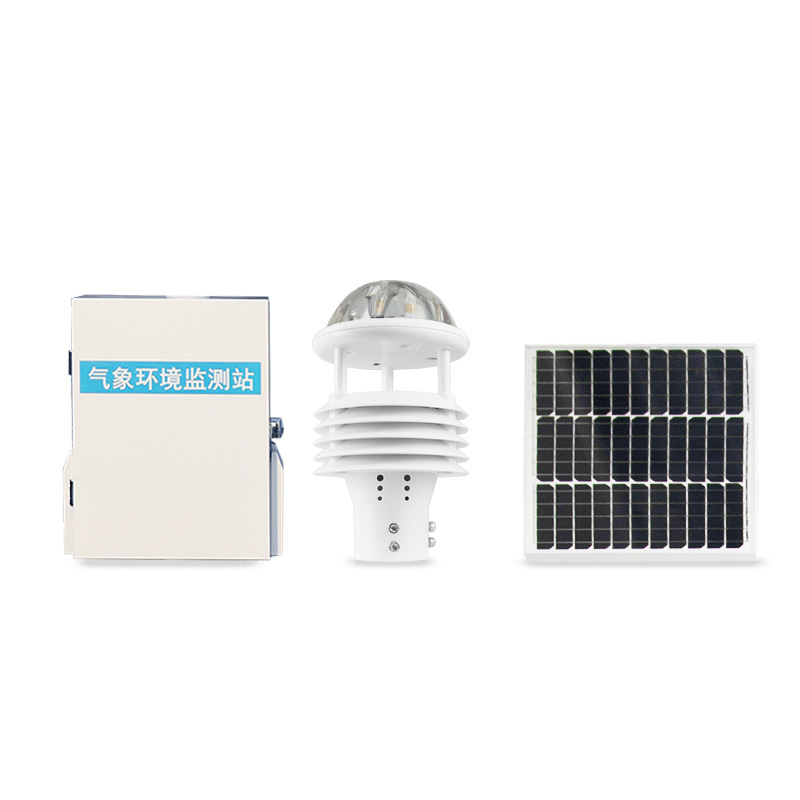
This system utilizes digital electric field detection technology, equipped with MEMS induction probes, and optimized early warning algorithms to reduce false alarms. It supports remote cloud-based monitoring networking, providing short-term, localized lightning safety early warning services fo...
On the rooftops of distributed photovoltaic power stations and between small photovoltaic arrays, a compact and sophisticated monitoring device is often seen – this is the PV Weather Station. With its small size, flexible deployment, and precise monitoring capabilities, it provides reliable data fo...
This Plant Disease Detection and Monitoring device integrates meteorological monitoring with intelligent spore-trapping and microscopic imaging. It automatically collects data on crop growth environments and disease spore information, utilizing built-in models to predict the onset trends of wheat st...
The intelligent weather station is a highly integrated, low-power, and quickly installable high-precision automatic meteorological observation device. It can monitor meteorological elements such as wind speed, wind direction, temperature, humidity, air pressure, optical rainfall, PM2.5, PM10,...


 Skype
Skype
 whatsapp
 mail
mail