Shandong Fengtu IOT Technology Co., Ltd
Sales Manager:Ms. Emily Wang
Cel,Whatsapp,Wechat:+86 15898932201
Email:info@fengtutec.com
Add:No. 155 Optoelectronic Industry Accelerator, Gaoxin District, Weifang, Shandong, China


Sales Manager:Ms. Emily Wang
Cel,Whatsapp,Wechat:+86 15898932201
Email:info@fengtutec.com
Add:No. 155 Optoelectronic Industry Accelerator, Gaoxin District, Weifang, Shandong, China
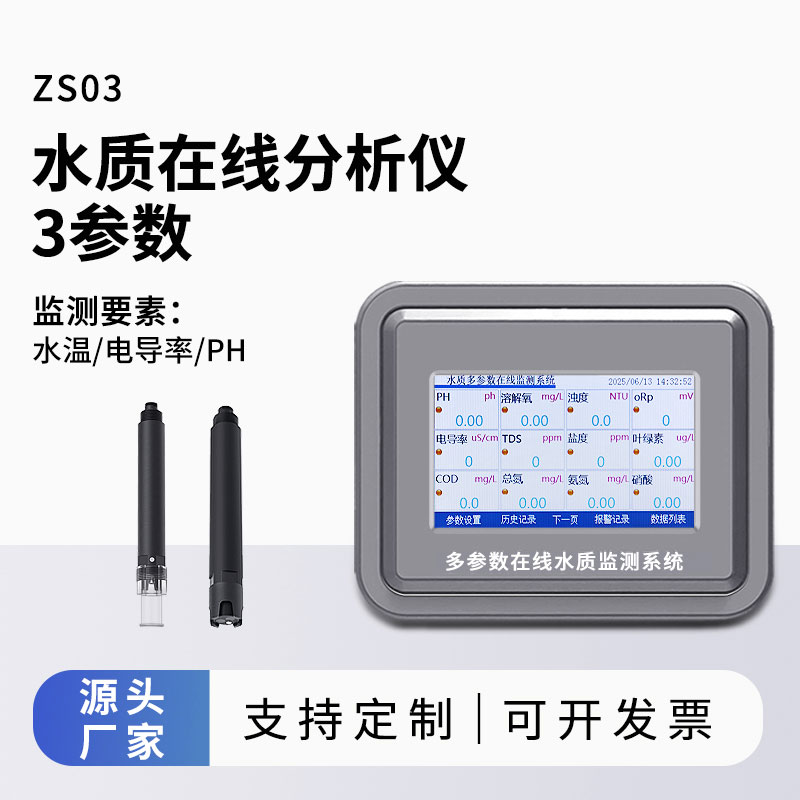
Model:FT-ZS03
Brand:fengtu
1.Water Quality Monitoring System Product Introduction
Water Quality Monitoring SystemZS03 is an instrument that can measure multiple water quality parameters at the same time. It integrates multiple sensors and measurement module communication storage, and can quickly and accurately record multiple key parameters in the water body. Including but not limited to water temperature, conductivity, pH, etc., it can be combined and configured according to different needs and applications, record and store historical monitoring data, alarm history records, and support historical data export.xlsx. The RS485 interface supports MODBUS-RTU communication protocol to facilitate users to freely communicate with PLC, DCS, configuration software, DTU and other devices to connect and transmit data.
2. Application fields of Water Quality Monitoring System
ZS03Water Quality Monitoring System is widely used in monitoring and controlling various water bodies, including but not limited to the following areas:
1. Water plant: used to monitor the pH value, dissolved oxygen, turbidity and other parameters of tap water to ensure the safety and hygiene of tap water.
2. Groundwater monitoring: used to monitor groundwater parameters such as pH value, conductivity, temperature, etc., so as to detect and solve water quality problems in time.
3. River and lake monitoring: used to monitor the water quality of rivers and lakes, such as dissolved oxygen, turbidity, ammonia nitrogen and other parameters, so as to take timely pollution control measures.
4. Ocean monitoring: used to monitor the water quality of the ocean, such as salinity, dissolved oxygen, temperature and other parameters, so as to timely detect and control marine pollution.
5. Sewage treatment: used to monitor sewage water quality parameters, such as pH, COD, ammonia nitrogen, etc., in order to control and adjust the sewage treatment process.
6. Industrial production: used to monitor water quality in industrial production processes, such as pH, conductivity, dissolved oxygen and other parameters, so as to adjust the process in time and ensure product quality.
7. Scientific research: used for water quality monitoring in the field of scientific research, such as lake eutrophication, climate change, etc.
3. Technical Features of Water Quality Monitoring System
1. High reliability: suitable for long-term work in the field environment, stable measurement and strong anti-interference ability.
2. Flexible and portable: Each probe can be freely combined, replaced independently, and plug and play.
3. Scalability: Various sensors can be freely combined.
4. Multiple applications: on-site rapid measurement, emergency monitoring, or long-term online monitoring of groundwater, river water, lake water, and urban pipe network water.
5. Tough shell: ABS+PC material, corrosion-resistant, can work normally for a long time.
6. Compact structure: can be installed in small places.
7. Communication connection: RS485 expansion interface, master/slave interface isolation and independent communication.
4. Technical Parameters of Water Quality Monitoring System
| Display Output | 4.3-inch touch screen with strong LED backlight, can be operated under direct sunlight |
| power supply | DC power supply: DC12V |
| Power consumption | The power consumption of the instrument is about 12V/1W |
| Sound Output | buzzer |
| Protocol | Standard RS485 Modbus-RTU protocol and device master/slave transmission channel support |
| Main material | ABS+PC material |
| storage temperature | -20 to 70°C |
| Operating temperature | -10 to 50°C |
| Protection level | IP65 |
| size | 175mm*140mm*49mm(length×width×height) |
| weight | About 0.5KG |
5. Water Quality Monitoring System Sensor Configuration
| Model | Name | Measurement range | Principle | Measurement accuracy | Resolution | Is it standard equipment | Note |
| S3 | pH | 0~14 (ph) | Electrochemistry (salt bridge) | ±0.1PH;±0.1℃ | 0.01 | √ | With warm supplement |
| S7 | Electrical conductivity | 0~10000uS/cm | Contact method of electrode | ±1.5%; ±0.1°C | 1uS/cm | √ | With warm supplement |
scenic weather station is a monitoring facility integrating data acquisition, storage, transmission, and management,It continuously monitors air quality and temperature/humidity to ensure the environmental quality of the scenic area....
The Greenhouse Water Drop Weather Station uses high-precision sensors to monitor air temperature, humidity, atmospheric pressure, light intensity, and CO2 concentration in real time. Data is wirelessly transmitted to a cloud platform via the Internet of Things (IoT), allowing users to view gre...
Question 1: What is a survey-grade integrated GNSS?"Survey-grade" means the device is specifically designed for high-precision measurement tasks, capable of achieving positioning accuracy from millimeter to centimeter level. It adopts differential RTK technology, which effectively eliminat...
Road Weather Sensors FT - N10 is feature - rich and capable of monitoring various weather phenomena such as rain, snow, hail, fog, dew, frost, and dust. It has high detection accuracy, adopting optical, acoustic, and other sensor technologies. The error in rainfall monitoring is small, and it can ac...


 Get a Free Quote
 Skype
Skype
 whatsapp
 mail
mail