Shandong Fengtu IOT Technology Co., Ltd
Sales Manager:Ms. Emily Wang
Cel,Whatsapp,Wechat:+86 15898932201
Email:info@fengtutec.com
Add:No. 155 Optoelectronic Industry Accelerator, Gaoxin District, Weifang, Shandong, China


Sales Manager:Ms. Emily Wang
Cel,Whatsapp,Wechat:+86 15898932201
Email:info@fengtutec.com
Add:No. 155 Optoelectronic Industry Accelerator, Gaoxin District, Weifang, Shandong, China
time:2026-06-16 14:23:50 source:Weather Station viewed:122 time
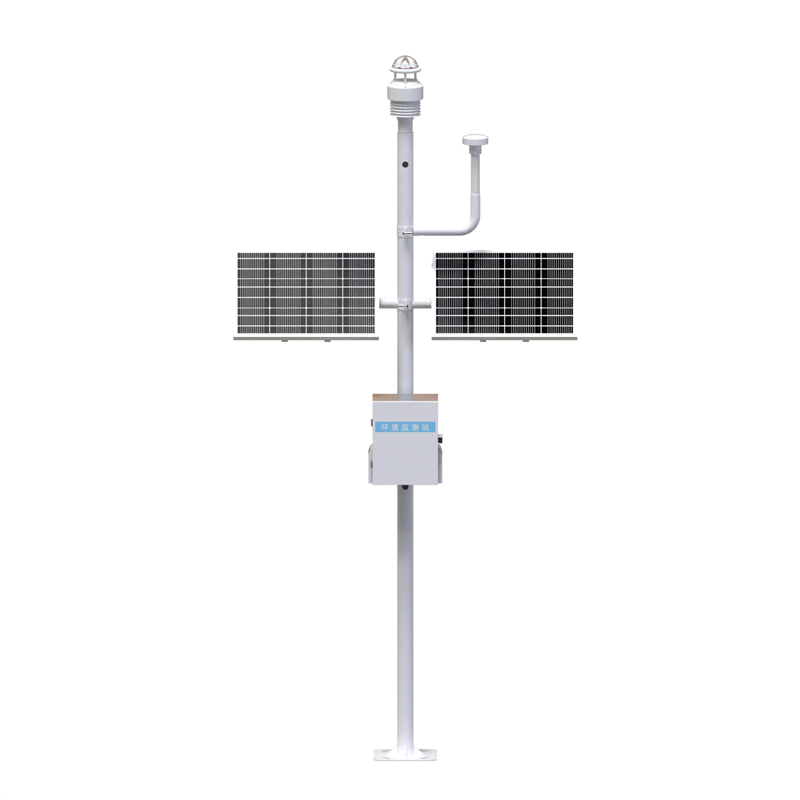
Integrating Beidou-3 short message communication with meteorological monitoring technology, the Beidou meteorological station employs an integrated eight-element sensor to monitor wind speed and direction, temperature and humidity, air pressure, optical rainfall, total radiation, and negative oxygen ions in real time. This enables continuous 24-hour online monitoring and data transmission in areas with no or weak signal coverage.
The Beidou meteorological station is an automated meteorological observation device that combines Beidou-3 regional short message communication technology with meteorological environmental monitoring technology. The system features autonomous operation, real-time transmission, intelligent monitoring, and accurate forecasting. It can monitor meteorological environmental changes 24 hours a day, effectively solving the environmental monitoring problem in areas with no or weak signal coverage. Currently, Beidou automatic weather stations are widely used throughout China, providing crucial support for weather forecasting and environmental early warning.
In terms of hardware configuration, the Beidou meteorological station adopts an eight-element integrated sensor, integrating real-time observation functions of meteorological elements such as ultrasonic wind speed and direction, temperature, humidity, atmospheric pressure, optical rainfall, total radiation, and negative oxygen ions. These eight parameters are output to the user simultaneously via a digital communication interface. The wind speed measurement range is 0 to 60 m/s, wind direction 0 to 360°, air temperature measurement range -40 to 80℃, humidity 0 to 100%RH, atmospheric pressure 300 to 1100 Hpa, optical rainfall 0 to 4 mm/min, total radiation 0 to 1242 W/m², and negative oxygen ions 0 to 100,000/cm³. The sensor housing is made of imported ASA material, with a protection rating of IP65 or higher, effectively resisting harsh environments such as salt spray.
Compared with traditional ultrasonic meteorological stations, the Beidou meteorological station overcomes the need for a high-precision timer, avoiding measurement inaccuracies caused by sensor start-up delay, demodulation circuit delay, and temperature changes. The equipment features a top-cover concealed ultrasonic probe design, avoiding interference from rain, snow accumulation, and natural wind obstruction. It emits continuously variable frequency ultrasonic signals and detects wind speed and direction by measuring the relative phase. The two-meter carbon steel bracket eliminates the need for a flange, allowing direct sensor mounting for convenient installation.
The BeiDou meteorological station supports two-way short message communication with BeiDou-3, transmitting up to 1000 Chinese characters in a single communication. It also supports BeiDou-3/GPS positioning and location reporting. The equipment is expandable to 4G full network connectivity, suitable for scenarios such as marine buoys, hydrological and water conservancy, and power data transmission. During the 2024 Northwest Pacific typhoon monitoring, the equipment provided valuable measured data for typhoon path forecasting by transmitting wind speed and air pressure data every 5 minutes. Leveraging its satellite communication and integrated sensor technology, the BeiDou meteorological station has become a core piece of equipment for meteorological monitoring in remote mountainous areas, marine islands, and uninhabited areas—situations with limited communication.
Tunnel spaces are relatively enclosed with limited ventilation. Exhaust emissions from large numbers of motor vehicles (especially diesel vehicles) contain significant amounts of suspended particles (such as soot, sulfates, etc.). These particles are difficult to disperse quickly and accumulate in t...
Agricultural Environment Monitoring System is a facility specifically designed for monitoring elements such as water, soil, and fertilizers in agricultural environments. It provides long-term dynamic monitoring of heavy metals, nutrient content, and pesticide residues, offering data support for agricultural environmental protection and remediation....
In the modern meteorological monitoring system, the Visibility sensor has achieved functional expansion and upgrade. It can not only accurately monitor visibility but also identify various weather phenomena, so it is called a visibility weather phenomenon instrument.This instrument is mainly based o...
Greenhouse weather station is equipped with high-precision sensors that can monitor environmental parameters such as temperature, humidity, light intensity, accumulated temperature, and accumulated light intensity in real time. Data is uploaded to a cloud platform via the Internet of Things (I...


 Skype
Skype
 whatsapp
 mail
mail