Shandong Fengtu IOT Technology Co., Ltd
Sales Manager:Ms. Emily Wang
Cel,Whatsapp,Wechat:+86 15898932201
Email:info@fengtutec.com
Add:No. 155 Optoelectronic Industry Accelerator, Gaoxin District, Weifang, Shandong, China


Sales Manager:Ms. Emily Wang
Cel,Whatsapp,Wechat:+86 15898932201
Email:info@fengtutec.com
Add:No. 155 Optoelectronic Industry Accelerator, Gaoxin District, Weifang, Shandong, China
time:2026-01-28 10:22:49 source:Weather Station viewed:429 time
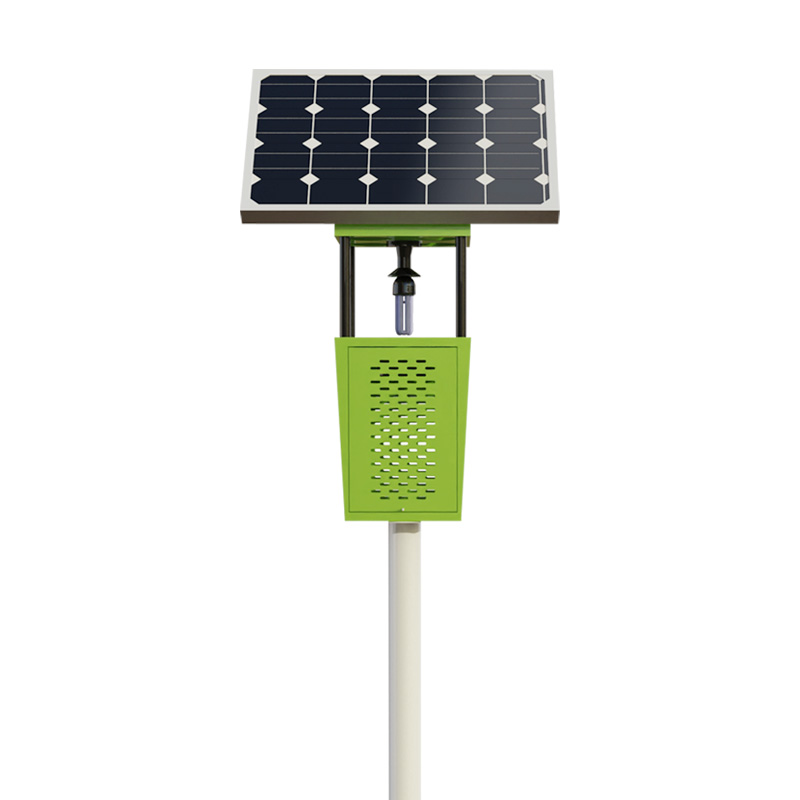
insecticide lamp is a solar-powered physical pest control device. It attracts pests using specific light wavelengths and then uses a negative pressure airflow generated by a fan to suck and capture the insects, effectively controlling field pests and reducing pesticide use.
insecticide lamp is a physical device specifically designed for agricultural and forestry pest control. It combines the insect-attracting principles of traditional insect traps with modern solar technology, intelligent control, and mechanical capture technology, providing an environmentally friendly pest management solution. Its core objective is to replace or reduce the use of chemical pesticides through physical means, thereby protecting the ecological environment and ensuring the safety of agricultural products.
The device's working principle is mainly based on the phototactic characteristics of pests and a mechanical capture mechanism. After the system starts, the lamp emits light waves of a specific wavelength, which is highly attractive to most pests. When pests are attracted to the light source and fly near the device, they will either touch the protective net on the periphery of the device or directly enter the capture area. At this point, the fan inside the device, which is in operation, plays a crucial role. The fan continuously rotates, creating a stable negative pressure airflow at the insect entry point of the device. This airflow generates an upward suction force that can quickly suck in various types of pests, regardless of their size, into the collection device inside the equipment.
Once the pests are sucked into the collector, the subsequent killing process begins. A common design involves the captured pests falling into a sealed collection bag or storage box. This part of the structure usually has dehydration or isolation functions, preventing the pests from escaping and ultimately causing them to die from dehydration. Some high-end models may also integrate vibration killing or other physical killing mechanisms to ensure effectiveness. The entire process of attraction, suction, and killing is fully automated and requires no manual intervention.
The device's energy comes entirely from solar power. It is equipped with photovoltaic panels on top, which convert solar energy into electricity during the day and store it in the built-in battery. The battery power supplies the insect-attracting light source, fan, and control system at night or when there is insufficient light. Intelligent light control technology is another key feature. The device can automatically sense ambient light intensity through a photosensitive sensor, enabling functions such as "automatic activation at dusk and automatic deactivation at dawn," and also features automatic sleep mode during rainy days, achieving highly intelligent and energy-efficient management.
In terms of application scenarios, insecticide lamp is widely applicable to outdoor environments requiring large-scale, long-term pest monitoring and control. In agricultural fields, it can effectively control various crop pests such as rice planthoppers and stem borers. In orchards, it helps reduce damage to fruits caused by fruit flies and moths. It also plays an important role in ecological maintenance in forest areas, tea plantations, urban green spaces, and organic farming bases. Besides directly killing pests to reduce population density, the collected insects can also be used as specimens for studying pest occurrence patterns, providing valuable data for pest forecasting.
In summary, insecticide lamp integrates solar power supply, specific light wave attraction, and negative pressure wind suction capture technology to create an efficient and automated physical pest control system. It produces no chemical residues, is safe for humans and animals, and while continuously reducing pest populations, it helps restore ecological balance in the fields. It is a practical and important technological equipment in modern green agriculture and sustainable forestry management.
Traditional cup anemometers are widely used in the field of wind power measurement, but they have obvious limitations. It can only measure the synthetic wind speed in the horizontal plane at the installation height of the wind measuring tower, and based on this, it can complete the statistical calcu...
Automatic Water Sampler is an intelligent device adapted for monitoring industrial wastewater and natural water bodies. It supports single and continuous mixed sampling of wastewater from discharge outlets, and features remote emptying, constant-temperature sample storage, and automatic dosing...
As high-precision lightning monitoring instruments, lightning detection sensors capture atmospheric electric field data in real time. When electric field values exceed a set threshold, the sensors issue an early warning—a capability well-suited for sectors such as meteorology, the chemical industry...
Atmospheric visibility is an important indicator in meteorological observations, and there are diverse methods for its measurement. The traditional visual estimation method is rather straightforward. It relies on observers to visually observe the target object and determine the maximum distance at w...


 Skype
Skype
 whatsapp
 mail
mail