Shandong Fengtu IOT Technology Co., Ltd
Sales Manager:Ms. Emily Wang
Cel,Whatsapp,Wechat:+86 15898932201
Email:info@fengtutec.com
Add:No. 155 Optoelectronic Industry Accelerator, Gaoxin District, Weifang, Shandong, China


Sales Manager:Ms. Emily Wang
Cel,Whatsapp,Wechat:+86 15898932201
Email:info@fengtutec.com
Add:No. 155 Optoelectronic Industry Accelerator, Gaoxin District, Weifang, Shandong, China
time:2026-04-30 10:31:03 source:Weather Station viewed:264 time
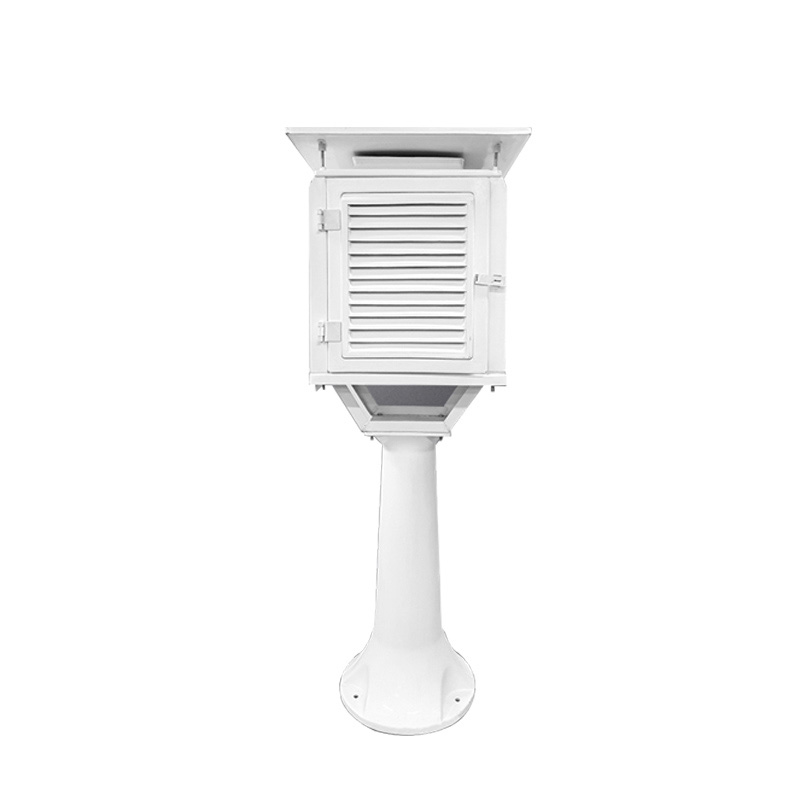
Weather Instrument Shelter consists of three main components—the housing body, connecting brackets, and base—all fabricated from premium fiberglass. This design effectively overcomes the inherent drawbacks of traditional wooden Stevenson screens, such as susceptibility to rot and cracking, and serves as a dedicated enclosure within meteorological stations for housing temperature and humidity observation instruments.
Weather Instrument Shelter is a critical piece of equipment in meteorological observation, designed to house and protect instruments such as thermometers and hygrometers. Comprising a louvered housing, connecting brackets, and a base, the unit is constructed entirely from high-grade fiberglass materials. Its exterior features a pristine, smooth white finish that requires no painting or maintenance, boasting a service life exceeding fifteen years. Compared to traditional wooden Stevenson screens, this fiberglass model exhibits a lower thermal conductivity and smaller heat capacity; furthermore, it possesses superior resistance to corrosion, cracking, and thermal radiation. It remains impervious to rot in rainy, acidic, or humid environments, and resists cracking even under arid conditions and intense sunlight, offering a service life far superior to that of its wooden counterparts.
In terms of structural design, Weather Instrument Shelter employs an inverted V-frame, layered fastening mechanism. Four vertical support rods run from top to bottom, interlacing through and securing twelve louvered slats. Together with the ventilated top cover and the base, these components form a robust, single-door enclosure that remains structurally sound and resistant to loosening. The external dimensions of the housing are 720 mm (width) x 780 mm (depth) x 880 mm (height); the internal volume measures 470 mm (length) x 465 mm (width) x 615 mm (height). The top cover measures 780 mm (length) x 720 mm (width) x 22 mm (thickness), with a 10 mm gap between the ventilation slats and the top cover. Internally, mounting brackets are installed in an alternating pattern on the base and the underside of the ventilated top cover; these are fitted with wooden shelves designed to securely anchor the internal observation instruments. The base support columns are constructed from fiberglass, while the connecting frame is fabricated from angle steel and features an electroplated surface finish. In terms of ventilation performance, the top cover features an inverted-funnel design; this allows for rapid air exchange between the interior and exterior of the enclosure—even during calm, windless conditions or periods of abrupt external environmental change—thereby enabling the internal and external environments to quickly reach equilibrium. This effectively overcomes the inherent drawback of data lag associated with traditional wooden Stevenson screens, resulting in observational data that is both more accurate and representative. Given its excellent thermal insulation properties—combined with features such as electrical suspension and superior ventilation, rain protection, radiation shielding, and insect resistance—this unit is ideally suited for widespread application in meteorological stations, hydrological stations, and environmental monitoring sites. It serves as an optimal housing solution for air temperature and humidity measurement equipment, and can also function as the primary shelter for automated hydrological and meteorological observation stations, effectively replacing traditional wooden Stevenson screens.
Research-grade equipment for environmental monitoringis becoming a tool for tourist attractions, nature reserves, and urban management departments.The concentration of negative air ions is one indicator of air quality. To meet the demand for atmospheric negative ion observation from relevant d...
Precipitation is a key component of the hydrological cycle. Accurate and timely rainfall data has irreplaceable value for water resource management, flood disaster warning, agricultural irrigation, and climate research. Traditional manual rainfall measurement methods have limitations in timeliness,...
The Negative oxygen ion monitoring station, as the core quantitative tool of a "natural oxygen bar", relies on technological means to transform the abstract air quality into perceivable and verifiable scientific indicators, playing an important supporting role in many fields such as ecolog...
In tunnel operation and management, safety is of paramount importance. Visibility and the brightness conditions inside and outside the tunnel directly affect drivers' visual experience and traffic safety. Therefore, a series of professional detection instruments are applied in tunnels. Below, we...


 Skype
Skype
 whatsapp
 mail
mail