Shandong Fengtu IOT Technology Co., Ltd
Sales Manager:Ms. Emily Wang
Cel,Whatsapp,Wechat:+86 15898932201
Email:info@fengtutec.com
Add:No. 155 Optoelectronic Industry Accelerator, Gaoxin District, Weifang, Shandong, China


Sales Manager:Ms. Emily Wang
Cel,Whatsapp,Wechat:+86 15898932201
Email:info@fengtutec.com
Add:No. 155 Optoelectronic Industry Accelerator, Gaoxin District, Weifang, Shandong, China
time:2026-07-20 10:53:40 source:Weather Station viewed:27 time
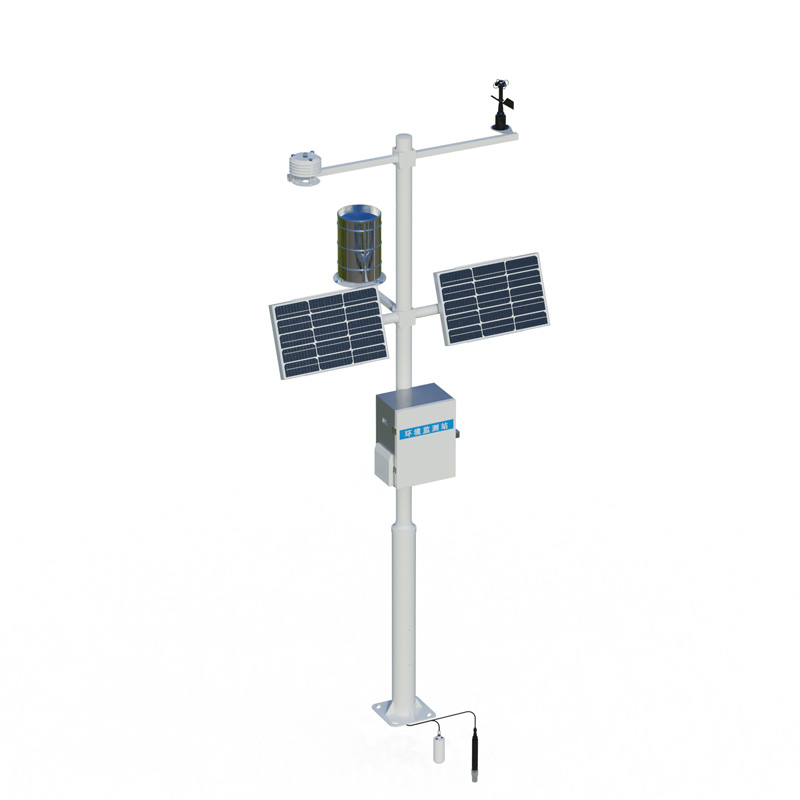
An agricultural microclimate observation station is a highly integrated, low-power, and rapidly installable high-precision meteorological observation device. It consists of five parts: meteorological sensors, a data logger, a solar power system, a pole support, and a cloud platform. It requires no debugging and can be quickly deployed, widely used in meteorology, agriculture, forestry, and scientific research.
An agricultural microclimate observation station is a scientific facility specifically designed to monitor changes in the microclimate environment within farmland. It can monitor key meteorological elements such as air temperature, humidity, light intensity, wind speed, precipitation, soil temperature, and soil moisture in real time. The device, composed of meteorological sensors, a data logger, a solar power system, a pole support, and a cloud platform, features high integration, low power consumption, and rapid installation, making it suitable for field monitoring.
Regarding sensor configuration, agricultural microclimate observation stations can monitor conventional meteorological elements such as air temperature, air humidity, wind direction, wind speed, and rainfall. They can also be equipped with optional sensors for soil temperature, soil moisture, light intensity, carbon dioxide concentration, and atmospheric pressure, depending on requirements. The equipment utilizes a solar power system, equipped with lead-acid batteries and an MPPT (Multi-Point Power Tracking) automatic power point charging controller, enabling it to maintain normal operation even during continuous cloudy or rainy weather. The data acquisition unit features a low-power design, with static power consumption of less than 50 microamps, standard GPRS networking capability, and supports extended Bluetooth and wired transmission. The equipment comes with a three-meter carbon steel bracket with two threaded connections for easy and quick installation and deployment. The protective case is made of ABS or stainless steel, possessing corrosion and oxidation resistance properties, and achieving an IP66 waterproof rating.
The agricultural microclimate observation equipment station is equipped with a cloud platform supporting a client-server architecture. Users can directly access observation data via a mobile phone or PC browser without installing additional software. The platform supports multiple accounts and multiple device logins, providing real-time and historical data dashboards. Collected data is uploaded to the cloud server via wireless transmission technology, allowing users to view real-time and historical data anytime, anywhere. The equipment supports exporting data in tabular format, supports data curve analysis, and has SMS alarm and threshold setting functions. When certain climate parameters exceed preset ranges, the system automatically sends warning information.
In terms of application scenarios, agricultural microclimate observation equipment stations are widely used in meteorological monitoring, agricultural production, forestry management, scientific research, and other fields. This equipment can form a mesoscale meteorological monitoring network, with each automatic weather station acting as a substation transmitting data to the central station. Based on soil moisture and precipitation data, farmers can precisely control irrigation volume and timing, avoiding over-irrigation that wastes water resources and causes soil nutrient loss. Combining meteorological data with crop growth stages, farmers can rationally adjust the type and amount of fertilizer applied, improving fertilizer utilization and reducing production costs.

The lightning early warning and monitoring system utilizes MEMS technology to develop its core electric field detection structure, eliminating mechanical parts prone to wear and tear. By combining electric field differentiation with optimized threshold algorithms, the system effectively avoids...
Precipitation is a key component of the hydrological cycle. Accurate and timely rainfall data has irreplaceable value for water resource management, flood disaster warning, agricultural irrigation, and climate research. Traditional manual rainfall measurement methods have limitations in timeliness,...
Tea garden insecticidal lamps is solar-powered and uses an insect-attracting light source to attract and kill pests. It is primarily used to trap and kill tea garden pests such as the tea green leafhopper, lepidopteran pests, leafhoppers, and inchworms. It is also suitable for pest control in...
The coal mine lightning early warning system employs a fully digital electric field detection architecture, integrating MEMS (Micro-Electro-Mechanical Systems) and charge-sensing technologies to establish its monitoring framework. By optimizing warning algorithms to mitigate false alarms caused by e...



 Skype
 whatsapp
 mail