Shandong Fengtu IOT Technology Co., Ltd
Sales Manager:Ms. Emily Wang
Cel,Whatsapp,Wechat:+86 15898932201
Email:info@fengtutec.com
Add:No. 155 Optoelectronic Industry Accelerator, Gaoxin District, Weifang, Shandong, China


Sales Manager:Ms. Emily Wang
Cel,Whatsapp,Wechat:+86 15898932201
Email:info@fengtutec.com
Add:No. 155 Optoelectronic Industry Accelerator, Gaoxin District, Weifang, Shandong, China
time:2025-12-18 10:26:54 source:Weather Station viewed:562 time
Lightning Warning System uses an atmospheric electric field sensor as its core to monitor changes in the electric field from -100kV/m to +100kV/m and predict thunderstorm trends in real time. It serves aerospace, power, petrochemical, and scenic areas, providing crucial early warning information for lightning protection.
Lightning Warning System is a high-tech safety device based on real-time atmospheric electric field monitoring for analyzing and predicting upcoming thunderstorm activity. By continuously detecting changes in atmospheric electric field strength, the system achieves early identification and warning of lightning formation, aiming to provide proactive lightning safety protection time windows for various fields and reduce casualties and property damage caused by lightning strikes.
The core technology of the system is ground-based atmospheric electric field monitoring. Its core sensor can measure the atmospheric electric field strength and its polarity changes within the range of -100kV/m to +100kV/m. Under clear weather conditions, the near-surface atmospheric electric field maintains a relatively stable background value. During the development, charge accumulation, and dissipation of thunderstorm clouds, a strong electrostatic field forms between the cloud base and the ground. The strength of this electric field changes significantly and specifically as the thunderstorm cloud approaches, develops, and dissipates. The system continuously captures this electric field change curve through a high-precision, high-sampling-rate electric field sensor network, serving as the most direct physical parameter for judging the occurrence, movement, and intensity trend of thunderstorms.
Effective early warning relies not only on hardware data acquisition but also on backend data communication and intelligent analysis algorithms. Multiple electric field sensors deployed within the monitoring area transmit real-time electric field data to a central data processing center via wired or wireless communication networks. The center's analysis platform integrates professional early warning algorithm models. These algorithms process continuous electric field time-series data, combining historical lightning databases and optional meteorological auxiliary information for comprehensive analysis. This allows the system to distinguish between local thunderstorms and transit cloud systems, identify the initial, active, and dissipation stages of thunderstorms, and calculate the probability of thunderstorm occurrence, estimated arrival time, and impact range.
At the application level, this system provides safety assurance for several key areas sensitive to lightning. In the aerospace and defense sectors, the system provides meteorological support and operational safety warnings for rocket launches, airport operations, and weapons storage. In meteorology, it serves as an important supplementary tool to short-term forecasting. In the petrochemical industry, early warnings for flammable and explosive locations such as oil depots, refineries, and open-air installations enable production shutdowns and personnel evacuations, preventing catastrophic accidents. In power systems, early warning information guides the power grid into special operating modes and schedules inspections and maintenance. In tourist attractions and large outdoor event venues, the system provides decision-making support for public safety evacuation. Furthermore, this system is widely used in mining, communications, and wind power sectors.
A complete Lightning Warning System system typically consists of an electric field sensor network, a data communication unit, a central processing server, and an early warning information dissemination platform. The early warning information dissemination platform is the user-facing interface, graphically displaying real-time electric field distribution, thunderstorm trajectories, warning areas, and warning levels. The system typically sets multiple warning thresholds, such as "Attention," "Warning," and "Alarm," and issues tiered warning instructions to designated personnel through various channels, including sound and light, SMS, software pop-ups, and broadcasts, guiding the implementation of appropriate emergency plans.
Therefore, by combining atmospheric electric field monitoring technology with modern communication and intelligent analysis technologies, Lightning Warning System has achieved a shift from passively accepting lightning disasters to actively preventing them. It provides valuable disaster preparedness time and has become an important technical disaster prevention tool in modern safety production and management systems, significantly improving the risk management capabilities and inherent safety levels of related industries under thunderstorm conditions.
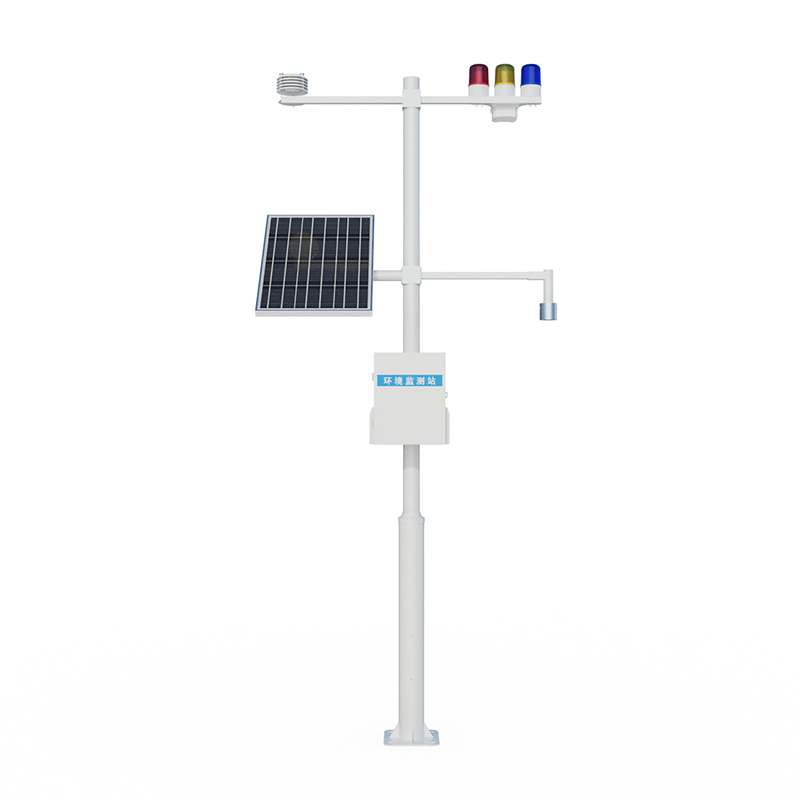
An atmospheric electric field meter is a remote sensing device for lightning detection that monitors lightning activity in real-time by measuring changes in the strength of the atmospheric electrostatic field. It can issue warnings 5 to 30 minutes prior to a lightning strike, providing a basis...
Greenhouse weather station is equipped with high-precision sensors that can monitor environmental parameters such as temperature, humidity, light intensity, accumulated temperature, and accumulated light intensity in real time. Data is uploaded to a cloud platform via the Internet of Things (I...
As industrialization speeds up and cities expand, air quality has become a growing concern. Traditional fixed - station air quality monitoring offers precise data but has drawbacks like high costs, limited monitoring areas, and inability to collect continuous spatiotemporal data. Mobile air quality...
The six-element micro weather station is equipped with an integrated sensor to monitor wind speed, wind direction, temperature, humidity, air pressure, and optical precipitation. Its casing meets salt spray protection standards and supports multiple transmission methods, making it suitable for...


 Skype
Skype
 whatsapp
 mail
mail